
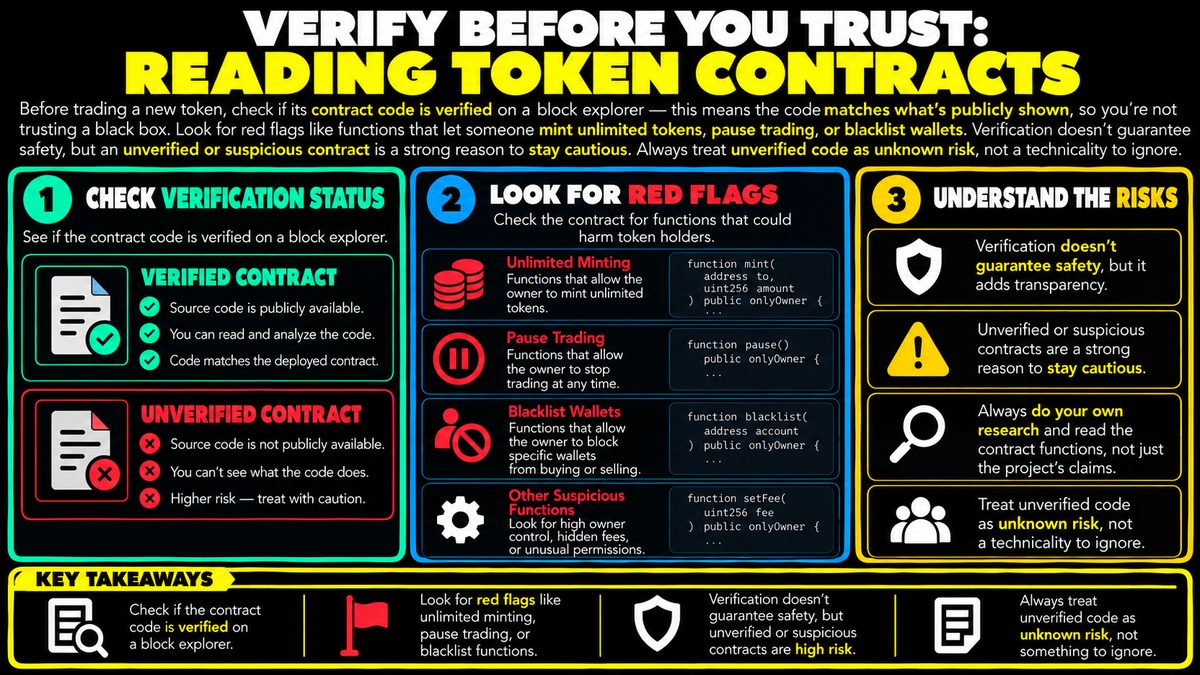
Before trading a new token, check if its contract code is verified on a block explorer — this means the code matches what's publicly shown, so you're not trusting a black box. Look for red flags like functions that let someone mint unlimited tokens, pause trading, or blacklist wallets. Verification doesn't guarantee safety, but an unverified or suspicious contract is a strong reason to stay cautious. Always treat unverified code as unknown risk, not a technicality to ignore.
What Contract Verification Actually Means
Every token on a blockchain is powered by code, usually called a smart contract. This code decides how the token can be created, transferred, and sometimes restricted. When developers deploy a contract, what actually sits on the blockchain is compiled code, a string of numbers that is unreadable to humans. Verification is the process of publishing the original, human-readable source code and proving it matches that compiled version exactly.
A block explorer is a website that lets anyone look up wallet addresses, transactions, and contracts on a given blockchain. Most major explorers have a feature where a contract shows a green checkmark or a label like verified source code. This means you, or anyone else, can actually read what the contract does rather than trusting the developer's word for it. An unverified contract is effectively a black box, you are trusting that it does what the team claims without any way to check.
How to Actually Read the Code
You do not need to be a programmer to get value from checking a contract, though some familiarity helps. Explorers often let you read the code directly on the page, and many also auto-generate a plain list of functions, the named actions the contract can perform. Scan this list for anything that gives one wallet unusual power over the token.
Common red flags include a mint function with no cap, which lets someone create unlimited new tokens, diluting everyone else's holdings. Another is a pause function that lets an owner freeze all trading at will. A blacklist function is also worth noting, since it can block specific wallets from selling while others trade freely. None of these features automatically mean a scam, some are legitimate design choices disclosed upfront, but unexplained or hidden versions of them are a serious warning sign.
Ownership and Permissions Matter Too
Beyond individual functions, check who controls the contract. Many contracts have an owner address with special privileges. If that ownership has not been renounced, meaning given up, or locked through a time delay, a single wallet may retain the power to change rules after people have already bought in. Imagine a hypothetical token where the owner wallet can change the trading fee from 1 percent to 50 percent at any moment, that kind of unchecked power is exactly what reading the contract can reveal in advance.
What Verification Does Not Guarantee
Verification only confirms that the published code matches what is deployed, it does not confirm the code is safe, fair, or free of exploitable bugs. A contract can be fully verified and still contain a deliberately malicious mint function or a cleverly hidden backdoor. Verification removes one layer of uncertainty, not all of them. Treat it as a minimum bar to clear, not a seal of approval.
Fitting This Into a Broader Risk Process
Contract review works best alongside other checks, such as looking at how tokens are distributed among wallets, whether liquidity is locked, and how long the project has existed. No single check, including this one, can tell you what a token's price will do. Treat unverified or suspicious contracts as unknown risk rather than a minor technicality, and size any position accordingly, since no amount of research eliminates the possibility of loss in crypto markets.