
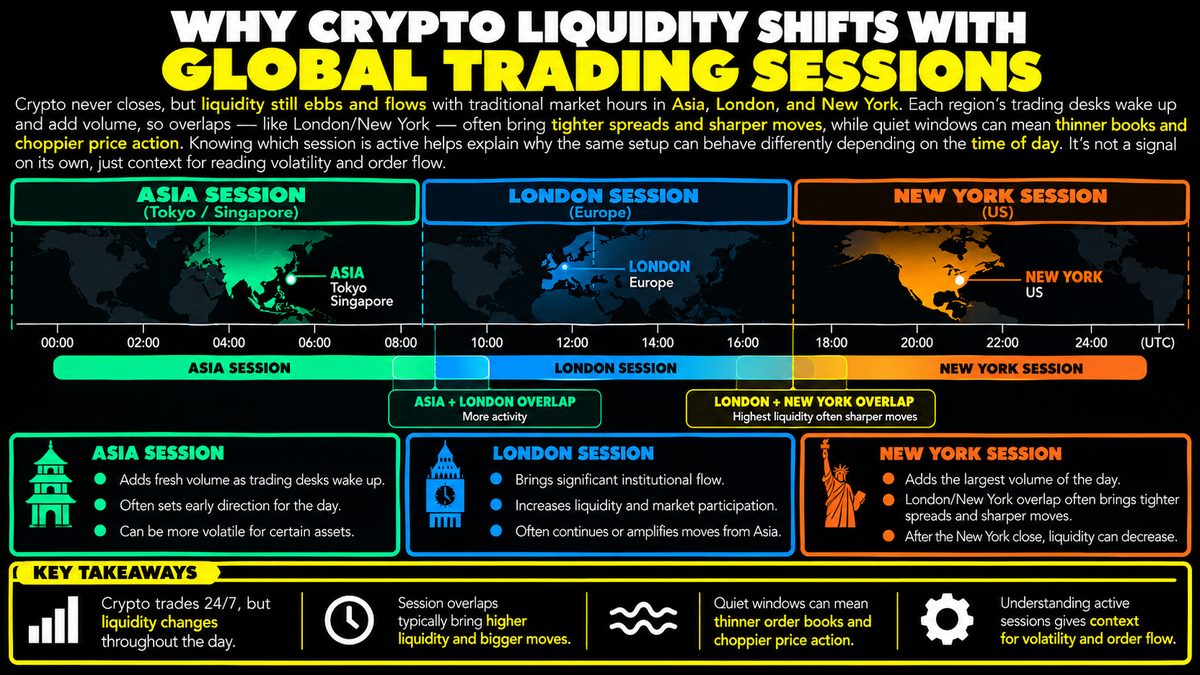
Crypto never closes, but liquidity still ebbs and flows with traditional market hours in Asia, London, and New York. Each region's trading desks wake up and add volume, so overlaps — like London/New York — often bring tighter spreads and sharper moves, while quiet windows can mean thinner books and choppier price action. Knowing which session is active helps explain why the same setup can behave differently depending on the time of day. It's not a signal on its own, just context for reading volatility and order flow.
How Trading Sessions Shape Crypto Markets
Crypto markets trade around the clock, but that does not mean activity is spread evenly across every hour. Liquidity, which simply means how much buying and selling interest is available at any given moment, still follows rhythms set by traditional financial centers. When major trading desks in a region come online, they tend to bring more orders, more capital, and more attention to the market, even though crypto itself has no official opening bell.
The three regions most often referenced are Asia, London, and New York. Each has rough working hours when its banks, funds, and active traders are online and engaged. As one region winds down and another wakes up, the character of the market can shift, sometimes subtly and sometimes quite noticeably.
Why Liquidity Rises and Falls
Liquidity thickens when more participants are actively placing orders, because a deeper order book, the list of buy and sell orders waiting to be filled, makes it easier to trade without moving the price much. During quieter hours, when fewer major desks are active, the order book can thin out. Thinner books mean the same size trade can push price further, leading to choppier or more erratic movement that does not necessarily reflect new information, just a temporarily shallower market.
This is why identical price setups can behave very differently depending on when they occur. A pattern that looks clean during a busy session might produce false signals or exaggerated spikes during a quiet one, simply because there is less depth absorbing the order flow.
The Overlap Effect
Some of the more closely watched windows are overlaps, periods when two major regions are active at the same time, such as when London trading hours begin to overlap with New York's. These overlaps often bring higher combined participation, which can mean tighter spreads, the gap between the best available buy and sell price, and sometimes sharper, faster price moves as more orders compete at once.
It is important to understand this as a tendency, not a rule. Overlaps do not guarantee volatility, and quiet sessions do not guarantee calm. Markets are influenced by many factors at once, including news, broader risk sentiment, and activity from large holders, any of which can override the usual session pattern on a given day.
Using Session Timing as Context, Not a Signal
Session awareness is best treated as background context rather than a trading trigger. Knowing that a quiet window is approaching might help explain why price action feels sluggish or erratic, and knowing an overlap is beginning might help explain why spreads suddenly tighten or volatility picks up. But none of this tells you direction, and it does not predict whether a move will continue or reverse.
Traders who rely too heavily on session timing can fall into the trap of expecting mechanical behavior from the market, such as assuming a certain hour always brings a reversal. Crypto markets are influenced by global participants at all hours, and unusual activity can occur at any time.
Combining Session Awareness With Other Tools
Because session timing only describes the environment rather than market direction, it works best alongside other forms of analysis, such as volume trends, chart structure, or broader market sentiment. Understanding that liquidity is thin, for example, might encourage a trader to be more cautious about position sizing or more aware of the risk of wider price swings on smaller orders.
Risk management remains essential regardless of session. No timing pattern removes the uncertainty inherent in markets, and liquidity conditions can change quickly. Treating session awareness as one small piece of a broader framework, rather than a standalone strategy, is a more realistic way to use this information.