
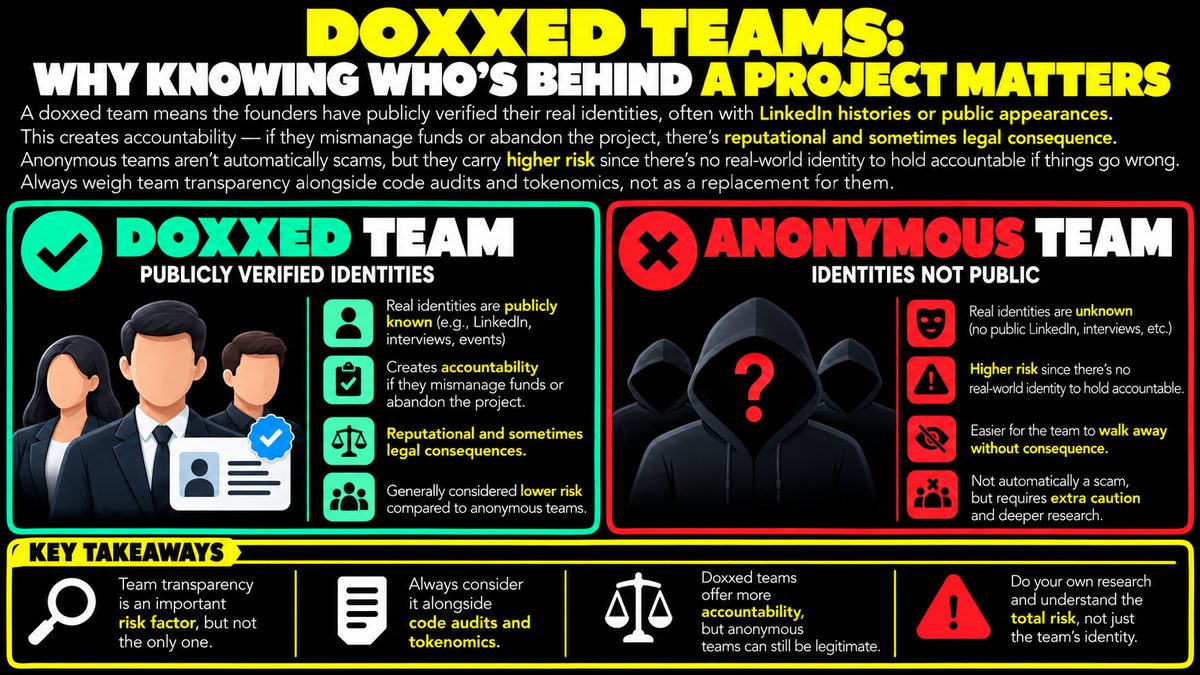
A doxxed team means the founders have publicly verified their real identities, often with LinkedIn histories or public appearances. This creates accountability — if they mismanage funds or abandon the project, there's reputational and sometimes legal consequence. Anonymous teams aren't automatically scams, but they carry higher risk since there's no real-world identity to hold accountable if things go wrong. Always weigh team transparency alongside code audits and tokenomics, not as a replacement for them.
What Doxxing Actually Means
In crypto, a doxxed team refers to founders or core developers who have voluntarily attached their real-world identity to a project. This usually means real names, verifiable employment histories, social media profiles that predate the project, or appearances at public events and interviews. The idea is simple: these are not pseudonymous figures hiding behind avatars, but people who can, in theory, be found, contacted, and held responsible.
This matters because crypto projects often ask people to send funds to addresses controlled by strangers on the internet. Knowing a real name does not make those funds safe, but it does change the risk calculus. A person who has staked their professional reputation on a project has something to lose beyond the project itself, which is a meaningfully different situation than an anonymous handle that can disappear overnight.
How Accountability Actually Works
The accountability doxxing creates is social and sometimes legal, not automatic or guaranteed. If a doxxed founder mismanages funds, misleads investors, or abandons a project, their name becomes permanently associated with that failure. This can affect their ability to raise money again, get hired, or operate in the same industry. In some jurisdictions, identifiable individuals can also face legal action or regulatory scrutiny in ways that anonymous actors simply cannot.
That said, accountability is not instant justice. Legal processes are slow, cross-border enforcement is complicated, and reputational damage does not refund anyone's losses. Doxxing raises the cost of bad behavior; it does not eliminate the possibility of it.
Why Anonymous Teams Are Not Automatically Scams
Anonymity in crypto has a long history tied to privacy values and, in some cases, legitimate concerns like regulatory uncertainty or personal safety. Plenty of anonymous teams have shipped working products without ever revealing who they are. Treating every pseudonymous project as a scam ignores this reality.
At the same time, anonymity removes a layer of friction that might otherwise discourage bad actors. If a project disappears, there is no name to chase, no LinkedIn profile to flag, no professional network to warn. This is why anonymous teams are generally considered higher risk, not because anonymity equals fraud, but because the downside protections available to a trader are fewer.
Reading Doxxed Claims Critically
Not all doxxing is equal. A founder appearing once at a conference is different from someone with a decade-long, verifiable public career. Traders should look at whether the identity claims can actually be cross-checked through independent sources, rather than taking a profile picture or a name on a website at face value. Fabricated or exaggerated credentials are not unheard of.
It also helps to separate doxxing from competence. A real, verifiable person can still make poor decisions, lack relevant experience, or simply fail. Identity reduces one category of risk, not all of them.
Fitting This Into a Broader Risk Framework
Team transparency is one input among several, not a standalone signal. A doxxed team with no code audit, unclear tokenomics, or a business model that does not make sense still carries real risk. Conversely, a strong technical foundation can exist alongside an anonymous team.
Reasonable practice is to weigh identity alongside independent code audits, how tokens are distributed and unlocked over time, the clarity of the project's purpose, and general position sizing discipline. No single factor, including a doxxed founder, is a guarantee against loss, and nothing here should be read as advice to act in any particular way.