
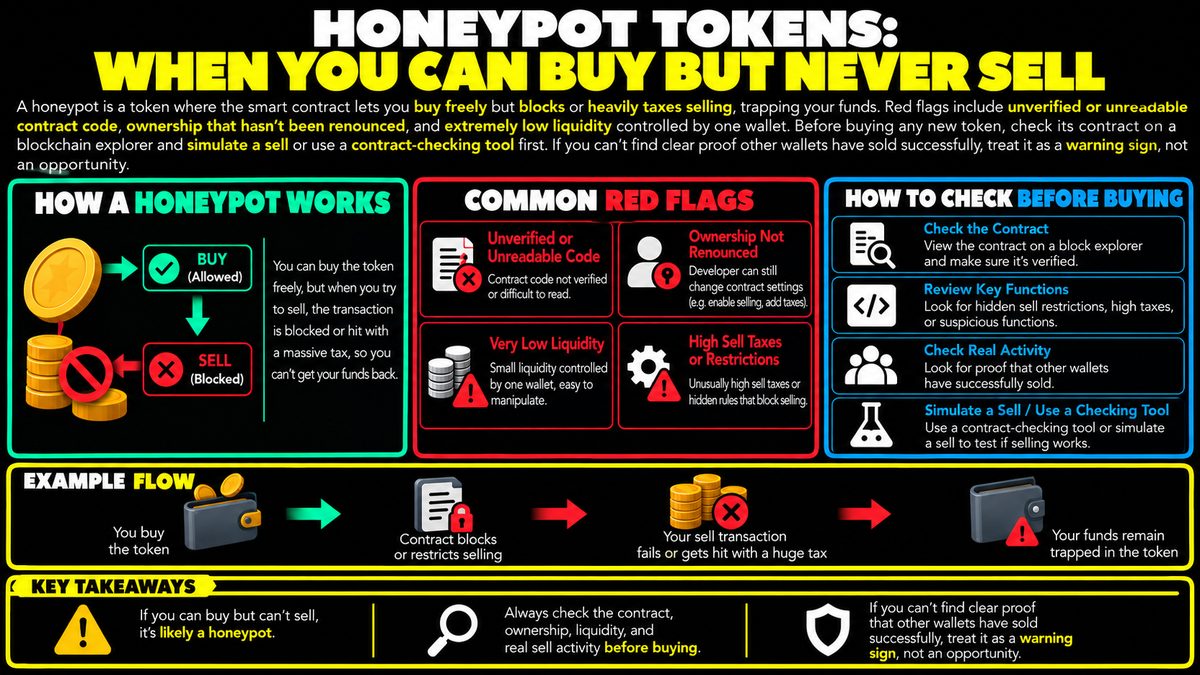
A honeypot is a token where the smart contract lets you buy freely but blocks or heavily taxes selling, trapping your funds. Red flags include unverified or unreadable contract code, ownership that hasn't been renounced, and extremely low liquidity controlled by one wallet. Before buying any new token, check its contract on a blockchain explorer and simulate a sell or use a contract-checking tool first. If you can't find clear proof other wallets have sold successfully, treat it as a warning sign, not an opportunity.
How The Trap Works
A honeypot token is built using a smart contract, which is simply the code that defines how a token behaves on a blockchain. In a normal token, that code lets anyone buy and sell freely on a decentralized exchange, a platform where trades happen automatically through contracts rather than a company matching orders. In a honeypot, the creator writes hidden rules into that same code so that buying works perfectly, but selling is blocked entirely, restricted to a special wallet, or taxed so heavily that you effectively lose most or all of your money trying to exit.
The reason this works is psychological as much as technical. Seeing a token that you can buy, that shows a rising price, and that appears to have other holders creates a false sense of normal market activity. Many buyers never attempt a test sell before committing real money, so the trap stays hidden until they try to cash out and discover the exit is blocked.
Why It Forms
Creating a honeypot does not require advanced skill. Anyone can copy a standard token template, insert a few lines that check whether the seller is the contract owner or an approved address, and deploy it in minutes. Because new tokens launch constantly, and because many traders are drawn to the idea of getting into something early, there is a steady supply of buyers willing to take a chance on an unverified project before doing any research.
Reading The Warning Signs
Before putting money into any new token, it helps to look at the contract directly on a blockchain explorer, a website that lets anyone view the raw code and transaction history behind a token. If the contract is unverified, meaning the human-readable source code was never published alongside the deployed version, that alone is a significant red flag because it hides exactly what the token can do.
Ownership that has not been renounced is another warning sign. Renouncing ownership means the creator has given up special control over the contract, such as the ability to change tax rates or freeze trading. If a single wallet still holds that power, it can alter the rules at any time. Extremely low liquidity, meaning very little money sitting in the trading pool that makes buying and selling possible, is also concerning, especially if most of that liquidity is controlled by one wallet that could remove it or block trades.
Practical Checks Before Buying
Several free tools exist specifically to simulate a sell transaction before you risk real funds, showing whether a transaction would succeed and what tax it would apply. Using one of these, or manually checking a block explorer for a history of wallets that successfully bought and then sold the token, gives you real evidence rather than assumptions. If you search and cannot find any proof that other holders have sold successfully, that absence of evidence should be treated as a warning rather than an opportunity waiting to be seized.
Limits Of These Checks
No single check guarantees safety. Scammers adapt their code to pass basic automated scans, and liquidity conditions can change quickly. These checks reduce risk and catch obvious traps, but they are not a substitute for broader caution, including only risking money you can afford to lose and treating unverified, newly launched tokens as inherently higher risk regardless of how promising the activity looks.