
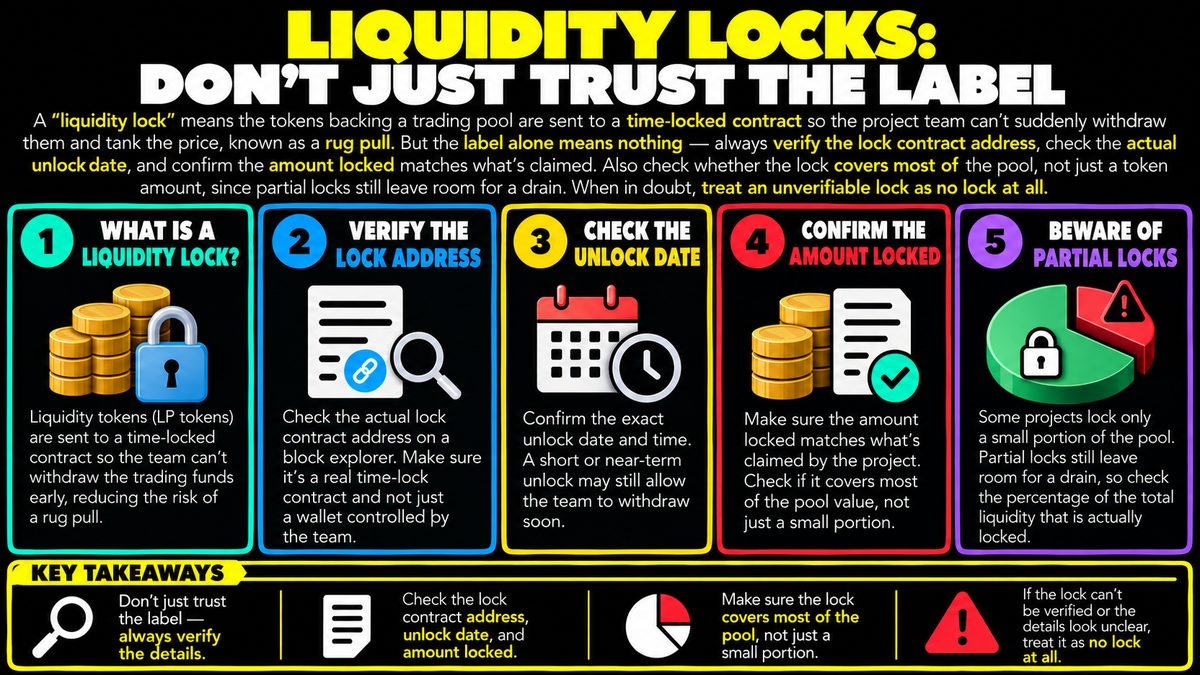
A "liquidity lock" means the tokens backing a trading pool are sent to a time-locked contract so the project team can't suddenly withdraw them and tank the price, known as a rug pull. But the label alone means nothing—always verify the lock contract address, check the actual unlock date, and confirm the amount locked matches what's claimed. Also check whether the lock covers most of the pool, not just a token amount, since partial locks still leave room for a drain. When in doubt, treat an unverifiable lock as no lock at all.
What a Liquidity Lock Actually Does
When a new token launches on a decentralized exchange, it usually needs a trading pool, which is a pair of assets (say, the new token and a more established coin) sitting in a smart contract that lets people swap between them. The project team typically creates this pool and supplies both sides of it. Because they control the wallet that deposited those funds, they can, in theory, pull the funds back out at any time, draining the pool and leaving other holders with a token that has no way to be traded for anything of value. This is the basic mechanic behind a rug pull.
A liquidity lock is meant to close that door. Instead of the pool tokens, which represent a claim on the deposited funds, sitting in the team's regular wallet, they are sent to a separate smart contract that holds them until a set future date. Until that date passes, nobody, including the original depositor, can withdraw. In principle this removes the easiest and fastest way for a team to disappear with funds.
Why the Label Alone Proves Nothing
The phrase "liquidity locked" is just a claim until you can verify it on-chain. Anyone can write "LP locked" in a project description or on social media without ever actually locking anything, or they can lock a trivial amount while leaving the bulk of the pool untouched. A screenshot of a locking service is not proof either, since screenshots can be edited or taken from an unrelated transaction.
The only real verification is checking the blockchain explorer, which is a public website that lets anyone view transactions and contract activity, and confirming three things yourself. First, that the contract address claimed to hold the lock actually received the liquidity pool tokens, not some other asset. Second, that the unlock date is genuinely far enough out to matter, rather than a few hours away or already passed. Third, that the amount locked matches what the project claims, both in absolute terms and as a share of the total pool.
Partial Locks Still Leave Room for a Drain
Even a verified, real lock can be misleading if it only covers part of the liquidity. If a team locks a modest slice of the pool and keeps control of the rest, they can still withdraw their unlocked share and meaningfully damage the price, even though they technically have a locked contract to point to. A lock is only as protective as the percentage of the pool it actually covers, so checking that ratio matters as much as confirming the lock exists at all.
How Traders Commonly Use This Information
Experienced traders usually treat a verified, substantial, long-duration lock as one small positive data point among many, not a reason to trust a project on its own. It's often combined with checking who can still change contract code, whether ownership has been renounced, how tokens are distributed among holders, and whether the team is identifiable. None of these checks remove risk entirely; they only reduce specific categories of it.
Limits and Sensible Risk Management
A lock does nothing to stop other risks, such as hidden code that blocks selling, taxes that quietly change, or a team simply vanishing once the lock expires on schedule. Treat an unverifiable or unclear lock as equivalent to no lock at all, since optimism is not evidence. Position sizing, only risking money you can afford to lose entirely, and ongoing skepticism remain the real safeguards, regardless of what any label claims.