
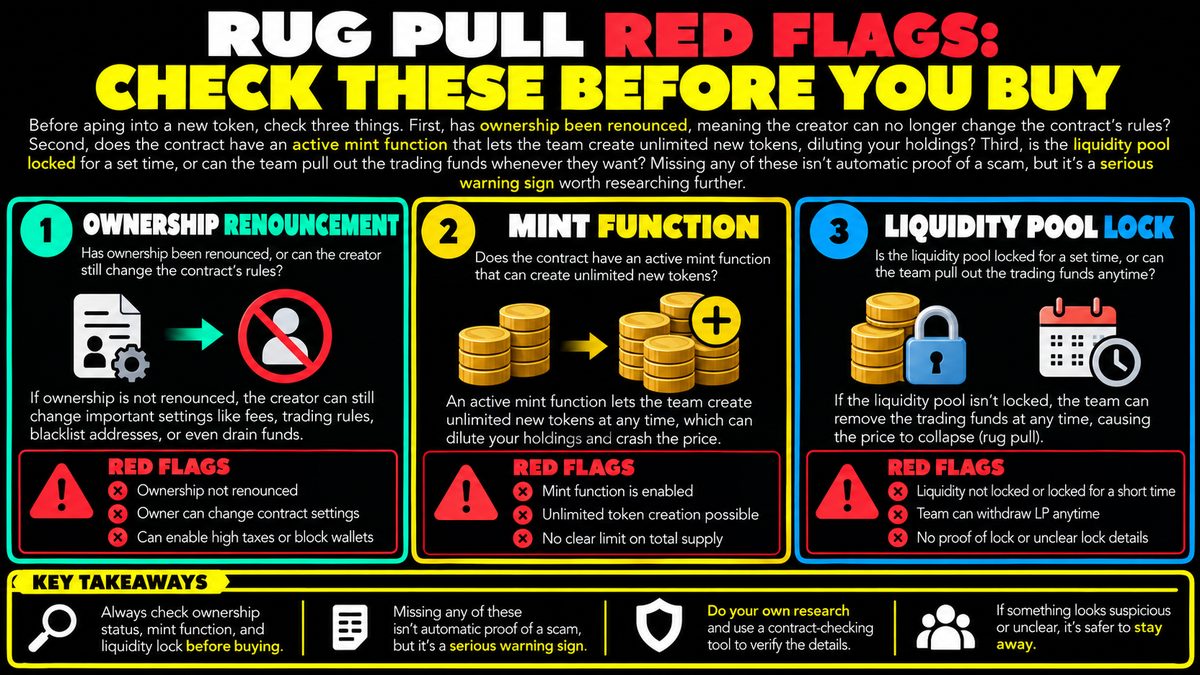
Before aping into a new token, check three things. First, has ownership been renounced, meaning the creator can no longer change the contract's rules? Second, does the contract have an active mint function that lets the team create unlimited new tokens, diluting your holdings? Third, is the liquidity pool locked for a set time, or can the team pull out the trading funds whenever they want? Missing any of these isn't automatic proof of a scam, but it's a serious warning sign worth researching further.
What A Rug Pull Actually Is
A rug pull happens when the people behind a token drain value from holders, usually by withdrawing the funds that back trading, minting huge amounts of new tokens, or quietly changing the contract rules in their favor. The term comes from "pulling the rug out" from under buyers who thought they had solid footing. It can happen fast, within minutes of a token launching, or slowly, as a team drip-feeds new supply or sells off reserved tokens over weeks.
Not every failed project is a rug pull. Sometimes a token just loses interest, has bad management, or fails technically. The difference is intent and control: a rug pull exploits a structural weakness the team deliberately kept in place. That is why checking the contract's structure before buying matters more than checking the marketing.
Ownership Renouncement
Smart contracts, the code that defines how a token behaves, often have an owner address with special permissions, such as the ability to change fees, pause trading, or blacklist wallets. Renouncing ownership means the creator gives up that special address, so nobody retains administrative control over the contract.
If ownership has not been renounced, the creator may still be able to alter core rules at will. This is not automatically malicious since some legitimate projects keep temporary control for upgrades or emergency fixes, but it does mean you are trusting a specific person or team rather than fixed code. Checking this status is usually possible through a blockchain explorer, a free website that lets anyone view contract details and transaction history for a given network.
Mint Function Risk
A mint function is code that allows new tokens to be created after launch. If this function is still active and controlled by the team, they can generate new tokens at will and sell them, which dilutes everyone else's share of the total supply and can push the price down regardless of other market activity.
Some projects need minting for legitimate reasons, such as rewarding stakers or governance decisions, but in those cases, minting should be limited by clear rules written into the contract, not left to an unrestricted admin function. When reviewing a contract, looking for capped supply or disabled minting is a basic but meaningful check.
Liquidity Pool Locks
A liquidity pool is a pair of assets, often the new token and a more established coin, deposited into a trading venue so people can buy and sell without needing a matching counterparty. If the team can withdraw that pool whenever they like, they can drain the trading funds in an instant, leaving buyers holding a token with no way to sell it at a reasonable price.
A locked liquidity pool uses a separate contract to hold those funds for a fixed period, making an abrupt withdrawal impossible until the lock expires. Checking whether a lock exists, how long it lasts, and which service holds it can be done through public blockchain tools, and this single check has historically been one of the more reliable ways to screen out the fastest, most obvious scams.
Putting the Checks Together
None of these three checks alone proves safety or danger. A project could renounce ownership, cap its mint function, and lock liquidity, yet still fail for unrelated reasons, or it could skip all three and still operate honestly, though that is far less common. Treat missing checks as a prompt for deeper research, not a final verdict.
Combining contract checks with other habits, such as researching the team, reading the contract code or a third-party audit if one exists, and never risking more than you can afford to lose, builds a more complete picture. No single red flag, or its absence, is a guarantee of outcome, and these checks are informational steps, not investment advice.