
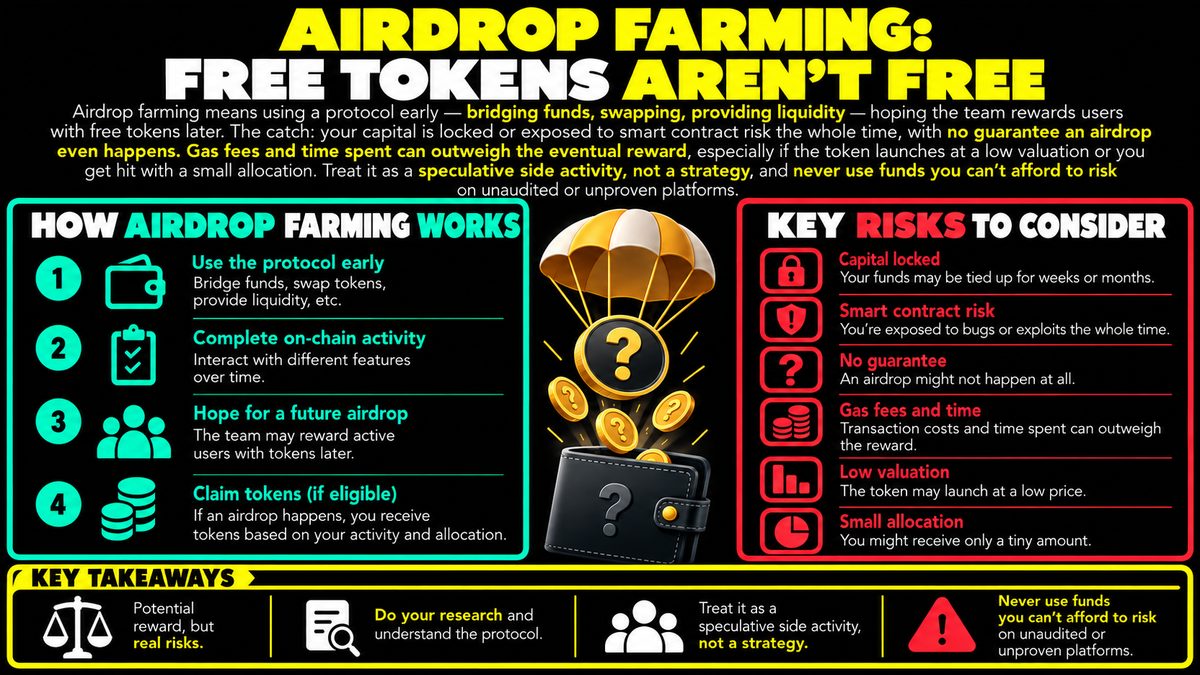
Airdrop farming means using a protocol early — bridging funds, swapping, providing liquidity — hoping the team rewards users with free tokens later. The catch: your capital is locked or exposed to smart contract risk the whole time, with no guarantee an airdrop even happens. Gas fees and time spent can outweigh the eventual reward, especially if the token launches at a low valuation or you get hit with a small allocation. Treat it as a speculative side activity, not a strategy, and never use funds you can't afford to risk on unaudited or unproven platforms.
What Airdrop Farming Actually Is
An airdrop is a distribution of free tokens, usually handed out by a new crypto project to people who used its platform before the token existed. Airdrop farming is the practice of deliberately interacting with these early-stage protocols purely in hopes of qualifying for a future reward. This might mean bridging funds from one blockchain to another, swapping between tokens, lending assets, or providing liquidity to a trading pool. None of these actions guarantee anything. A project may never launch a token, may launch one with little value, or may reward only a narrow set of addresses that farmers failed to match.
How the Farming Process Works
Typically a farmer researches new or pre-launch protocols, often through community chatter or speculation that a team is "likely" to reward users. They then perform a series of on-chain actions meant to look like genuine usage: depositing funds, making trades, holding positions for weeks or months. Projects that do eventually distribute tokens usually base allocations on criteria like transaction count, dollar volume moved, or length of participation. Because these criteria are rarely published in advance, farmers are often guessing at what behavior will count, which pushes some toward using multiple wallets or exaggerated activity to maximize their perceived involvement.
The Hidden Costs Most People Overlook
The word free is misleading. Every transaction on a blockchain costs a gas fee, a payment to the network for processing it, and these add up quickly across dozens of farming actions. Funds sitting in a bridge, a lending pool, or a liquidity pair are also exposed the entire time to smart contract risk, meaning a bug or exploit in the protocol's code could freeze or drain the funds entirely, with no recourse. On top of that is the opportunity cost of capital being locked away instead of used elsewhere, and the real time spent researching and executing all this activity. If the eventual airdrop is small, or the token launches at a low valuation, meaning the total market value assigned to it is modest, the reward can end up being worth far less than what was spent chasing it.
Reading the Risk Realistically
A useful mental exercise is to treat an expected airdrop as having a value of zero until tokens are actually sitting in your wallet and tradable. Before that point, nothing is owed to you, criteria can change, and distributions can be delayed indefinitely or canceled. If a strategy only makes sense because of an assumed future reward, it is standing on an assumption rather than a plan. Comparing farming to simply holding, saving, or deploying capital in a platform with an established track record can make the opportunity cost clearer.
Fitting It Into a Broader Trading Mindset
If you choose to farm airdrops, it helps to treat it the same way you would treat any other speculative side bet rather than a core strategy: size it small, use only funds you can genuinely afford to lose, and avoid spreading meaningful capital across unaudited or unproven platforms. Diversifying attention across too many new protocols can also multiply your exposure to smart contract failures rather than your chance of reward. Basic risk management still applies here, including limiting how much total capital touches experimental platforms at once and being honest with yourself about gas costs and time already sunk, since those are real losses regardless of what happens later. No airdrop is guaranteed, no allocation size is predictable in advance, and no pattern of past airdrops promises that future ones will behave the same way.