
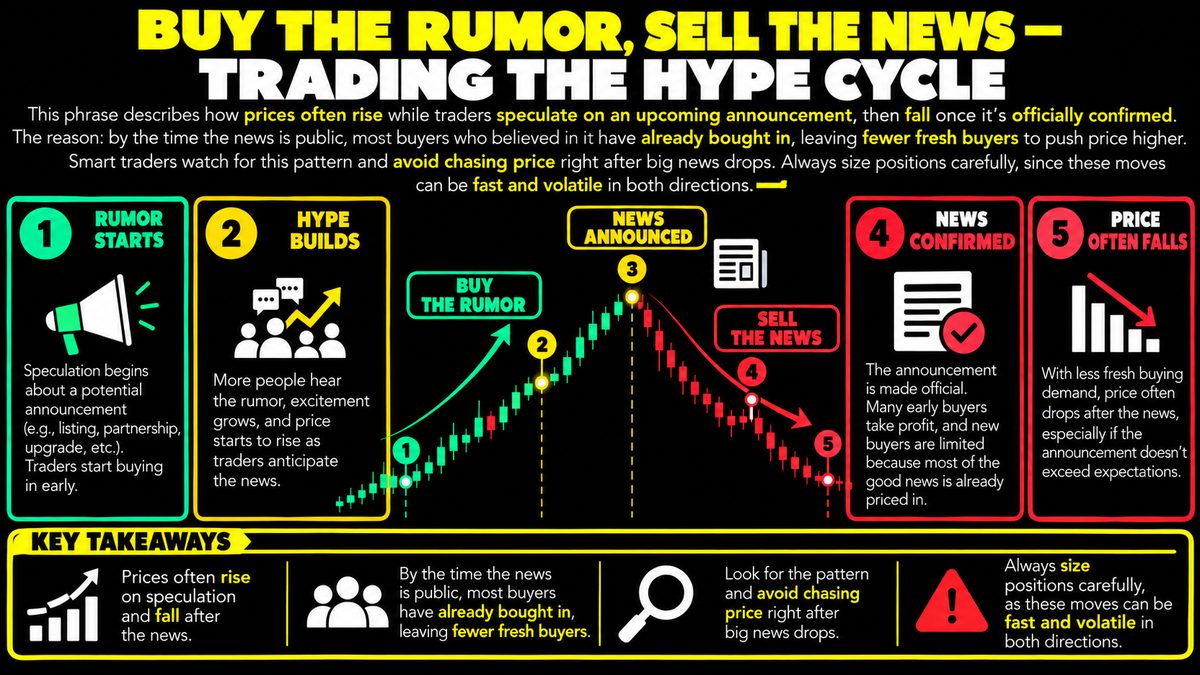
This phrase describes how prices often rise while traders speculate on an upcoming announcement, then fall once it's officially confirmed. The reason: by the time the news is public, most buyers who believed in it have already bought in, leaving fewer fresh buyers to push price higher. Smart traders watch for this pattern and avoid chasing price right after big news drops. Always size positions carefully, since these moves can be fast and volatile in both directions.
What the Phrase Actually Means
"Buy the rumor, sell the news" describes a recurring pattern in markets where price moves more on anticipation than on the actual event. Traders hear whispers of something significant coming, such as a protocol upgrade, a partnership, or a major listing, and they start buying in advance, hoping to profit once the news is confirmed. As more people pile in based on the same expectation, price often climbs steadily during this speculative phase.
Then, when the announcement finally happens, something counterintuitive often occurs: price stalls or even drops. This happens because the people who believed in the rumor already bought earlier. Once the news is public, there are fewer new buyers left to push price further, while some early buyers start taking profit, creating selling pressure right when the event finally plays out.
Why the Pattern Forms
Markets are forward-looking. Prices tend to reflect what traders expect to happen, not just what has already happened. This means that by the time information becomes official and widely known, it may already be priced in, meaning its expected impact has already been absorbed into the current price through anticipatory buying.
This is closely tied to a broader concept called market expectations. If a positive outcome is widely anticipated, confirmation of that exact outcome often does not add new information, so it does not necessarily create new buying demand. Surprises, whether better or worse than expected, tend to move price more than confirmation of what everyone already assumed.
How Traders Try to Use This Idea
Some traders try to position themselves before an anticipated event, planning to exit as the hype builds rather than waiting for the official announcement itself. Others specifically avoid buying right after a major headline drops, since that is often when the move is already mature and reversal risk is higher.
Volume and price behavior in the days leading up to an event are often watched closely. A steady climb beforehand followed by a sudden spike and stall near the announcement is a pattern some traders associate with this cycle. However, reading this pattern in real time is far from easy, and it does not play out the same way every time.
Common Mistakes and Limitations
A common mistake is assuming this pattern is guaranteed to repeat every single time news arrives. Markets are influenced by countless factors, and sometimes news exceeds expectations enough to push price higher anyway, or broader market conditions override the typical pattern entirely.
Another mistake is chasing price upward during the rumor phase without a clear plan, only to be caught holding when the reversal happens. Hype-driven moves can be extremely volatile, and timing an exit precisely is difficult even for experienced traders. There is no indicator that reliably predicts exactly when sentiment will shift.
Fitting This Into a Broader Strategy
This concept works best as context, not a standalone trading signal. It pairs naturally with basic risk management principles such as position sizing, using only an amount of capital you are prepared to lose on a given trade, and considering stop-loss levels to limit downside if the expected pattern fails to materialize.
Combining this awareness with broader analysis, such as overall trend, trading volume, and general market sentiment, gives a fuller picture than relying on the phrase alone. Ultimately, no pattern, including this one, guarantees a specific outcome, and treating it as a certainty rather than a tendency is one of the most common ways traders get caught off guard.