
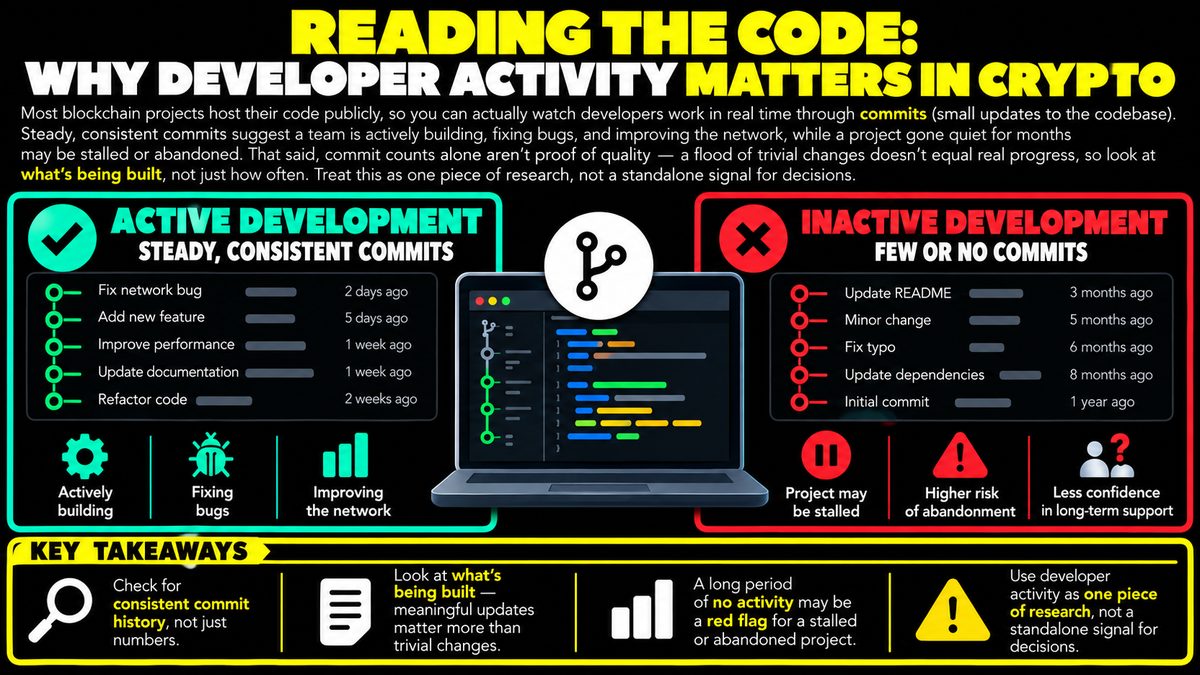
Most blockchain projects host their code publicly, so you can actually watch developers work in real time through commits (small updates to the codebase). Steady, consistent commits suggest a team is actively building, fixing bugs, and improving the network, while a project gone quiet for months may be stalled or abandoned. That said, commit counts alone aren't proof of quality — a flood of trivial changes doesn't equal real progress, so look at what's being built, not just how often. Treat this as one piece of research, not a standalone signal for decisions.
What Developer Activity Actually Means
Most blockchain projects are built as open-source software, meaning the underlying code is published publicly rather than locked away in a private company vault. This is usually hosted on code-sharing platforms where anyone can view the project's history. Every time a developer makes a change, however small, it gets logged as a commit. Over time these commits form a visible timeline of a project's development, almost like a diary of what the team has been working on.
This matters because, unlike a company's quarterly earnings report, you do not have to wait for an announcement to get a sense of whether a project is active. You can look directly at the commit history and see whether code is being written, tested, and merged into the main project on an ongoing basis.
How Commit Patterns Form
A healthy, actively maintained project tends to show a steady rhythm of commits over months and years, often from multiple contributors rather than just one person. This can include bug fixes, security patches, new features, or improvements to documentation. The pattern does not need to be dramatic or constant every single day, since development naturally slows during planning phases or picks up before a major release, but long stretches of near-total silence are worth noticing.
A project that has gone quiet for many months, with no commits, no merged changes, and no public discussion, may simply be between development cycles, or it may signal that the team has lost funding, lost interest, or moved on entirely. Neither explanation is guaranteed just from the activity graph alone, which is why this is a starting point for questions rather than a conclusion.
Reading Beyond the Numbers
A common mistake is treating commit count as a simple scoreboard, where more is automatically better. In reality, a developer can generate dozens of trivial commits, such as fixing typos in comments or reformatting text, without making any meaningful progress on the actual product. Conversely, a single commit might represent weeks of difficult work solving a core technical problem.
Because of this, it helps to look at what the commits actually describe, not just how many there are. Are contributors fixing reported security issues, expanding functionality, or responding to community feedback, or is most of the activity cosmetic. Reading commit messages and any linked discussion can reveal whether work is substantive or superficial, which raw counts cannot tell you on their own.
Limitations of This Research Method
Developer activity on a public code repository is not a complete picture of a project's health. Some teams work privately for periods of time before publishing their changes in large batches, which can make an active project look temporarily dormant. Other projects may have most of their meaningful work happen in private infrastructure that never appears in the visible commit history at all. There is also no way to confirm from commit activity alone whether a project's broader goals are realistic, whether its token economics make sense, or whether it has genuine demand.
Fitting This Into Broader Research
Developer activity is best treated as one input among many, alongside things like the project's documentation, its community discussions, how it compares to similar projects, and your own understanding of the problem it claims to solve. No single signal, whether it is code commits, social media activity, or trading volume, can reliably predict future outcomes on its own.
This kind of research does not replace careful risk management. Markets remain unpredictable, and even technically active, well-maintained projects carry risk, including the possibility of loss. Treat commit history as a useful lens for understanding a team's engagement, not as evidence of future performance or a basis for financial decisions.