
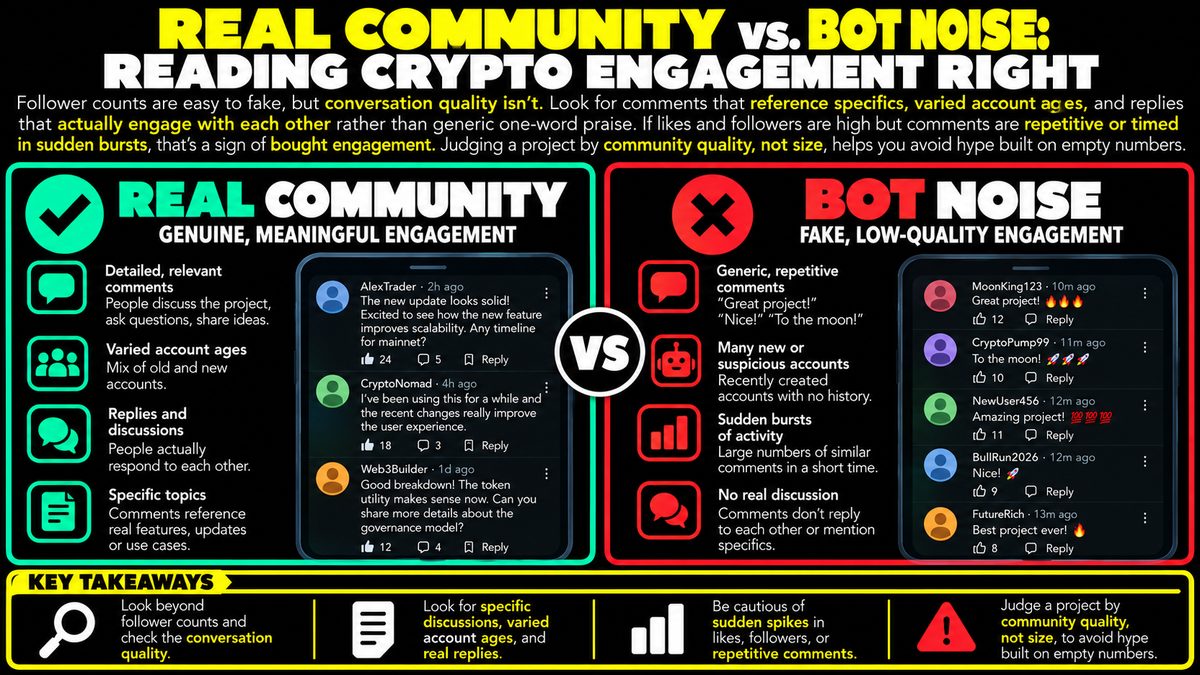
Follower counts are easy to fake, but conversation quality isn't. Look for comments that reference specifics, varied account ages, and replies that actually engage with each other rather than generic one-word praise. If likes and followers are high but comments are repetitive or timed in sudden bursts, that's a sign of bought engagement. Judging a project by community quality, not size, helps you avoid hype built on empty numbers.
Why follower counts mislead
A big follower number feels like proof that a project is trusted, but numbers alone say nothing about whether the people behind them are real, informed, or even paying attention. Follower counts, likes, and views can be purchased cheaply in bulk, and automated accounts, often called bots, can be programmed to follow, like, or repost content on command. This means a coin with a huge audience and a coin with almost no real audience can look identical at a glance. The only way to tell them apart is to look past the headline numbers and into the actual conversation happening underneath.
What genuine engagement looks like
Real community activity tends to be messy and specific. People ask awkward questions, disagree with each other, reference particular details like a feature, a past event, or a technical point, and reply directly to other comments rather than posting in isolation. Account ages are usually varied too, a mix of old and new profiles, rather than a cluster of accounts all created around the same time. Genuine discussion also tends to be inconsistent in tone, some excited, some skeptical, some bored, because real people do not all feel the same way at once.
Spotting bought or bot engagement
Bought engagement usually has a pattern you can learn to notice. Comments repeat similar phrasing, use generic praise like great project or to the moon with nothing else attached, or appear in sudden bursts rather than spreading out naturally over time. If a post gets thousands of likes within minutes but only a handful of comments, that mismatch is worth noticing. Clusters of accounts with near-identical creation dates, default profile pictures, or no posting history before that moment are another common signal. None of these signs alone proves manipulation, but several appearing together is a reasonable reason to slow down.
Why this matters for your decisions
Engagement quality is not a trading signal in the sense of telling you when to buy or sell, and it cannot predict where a price will go. What it can do is help you judge whether the enthusiasm around a project reflects actual interest or an artificial impression of interest. Hype built on empty numbers can still move a price in the short term, because enough people believing something is popular can itself attract attention, regardless of whether that belief is based on anything real. Understanding this helps you separate noise from substance when forming your own view.
Limits of this approach
Reading community quality is a skill, not a formula, and it will never give you certainty. Sophisticated manipulation can mimic natural conversation patterns, and some genuinely small or early projects simply have thin, quiet communities that look sparse without being fake. Conversely, a large and lively community does not guarantee a project is sound, well built, or free of risk, it only suggests the social layer around it is more organic. This kind of analysis should sit alongside other research, not replace it, and should never be treated as the deciding factor on its own.
Keeping it in perspective
Treat engagement analysis as one input among many, combined with your own understanding of the project, risk tolerance, and position sizing. No single clue, whether it is follower count, comment tone, or anything else, removes the underlying uncertainty of crypto markets. Approaching community signals with curiosity rather than certainty, and always verifying across multiple sources, is a more sustainable habit than searching for shortcuts that promise clarity where none really exists.