
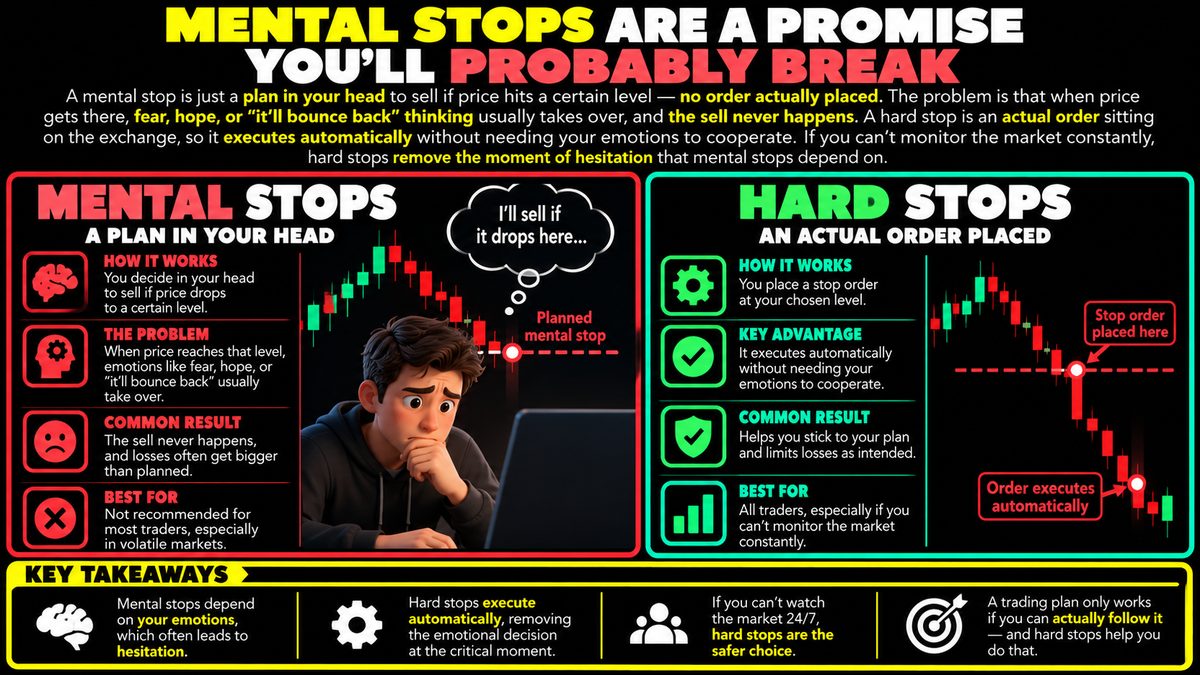
A mental stop is just a plan in your head to sell if price hits a certain level — no order actually placed. The problem is that when price gets there, fear, hope, or "it'll bounce back" thinking usually takes over, and the sell never happens. A hard stop is an actual order sitting on the exchange, so it executes automatically without needing your emotions to cooperate. If you can't monitor the market constantly, hard stops remove the moment of hesitation that mental stops depend on.
What a mental stop actually is
A stop, in trading terms, is simply a price level where you decide you'll exit a position, usually to limit how much you lose if a trade goes against you. A mental stop is when that level exists only in your head or in a notebook, not as an actual order on the exchange. You tell yourself something like, "if this drops to 90, I'm out," and then you wait, planning to manually sell when that moment comes.
The appeal is obvious. Mental stops feel flexible. You're not locked into anything, and you can change your mind if new information comes in. But that flexibility is exactly what makes them unreliable, because the person who set the plan and the person who has to execute it under pressure are, psychologically, not quite the same person.
Why the promise breaks down
Markets move fast, and price hitting your mental stop level is rarely a calm, neutral event. It usually comes with a red candle, a falling feeling in your stomach, and a flood of competing thoughts. Fear tells you to wait and see. Hope whispers that it will bounce back any second. A third voice argues that selling now would "lock in the loss," as if not selling somehow makes the loss less real.
This is a well-documented pattern in behavioral finance called loss aversion, where the pain of realizing a loss feels worse than the relief of avoiding it, even when avoiding it is irrational. Combined with the fact that you have to actively click sell, rather than something happening automatically, the mental stop asks you to make a hard decision at the exact moment you're least equipped to make it calmly.
How a hard stop removes the decision
A hard stop is a real order placed in advance on the exchange, often called a stop-loss order, that triggers automatically once price reaches your chosen level. You decide the exit point while you're calm, before you have any position-specific emotion attached to that exact moment, and the system carries it out without needing you to act again.
This doesn't make the stop smarter than a mental one, it just makes it immune to hesitation. The order doesn't hope, doesn't bargain, and doesn't need convincing. For anyone who can't watch a screen all day, this matters even more, because a mental stop depends entirely on you being present and alert exactly when price arrives, which is not realistic for most retail traders.
Where hard stops still have limits
Hard stops are not magic either. In fast or thin markets, a stop order can trigger at a worse price than intended, a phenomenon sometimes called slippage, especially during sudden volatility. Placing stops too close to current price can also mean getting exited by normal, meaningless wiggles before a trade has any real chance to play out. No stop, mental or hard, can predict where price will go next or guarantee you avoid losses altogether.
Fitting stops into a broader plan
A stop level is most useful when it's decided as part of a broader risk management plan, ideally tied to how much of your total capital you're willing to risk on a single trade, rather than picked emotionally after watching a chart move. Combining stop placement with position sizing and a clear reason for entering the trade in the first place tends to produce steadier decision-making than any single tool alone.
None of this removes risk from trading, and no stop, pattern, or indicator can promise an outcome. What a hard stop does is make sure that the plan you made with a clear head is the plan that actually gets followed, instead of quietly dissolving under pressure.