
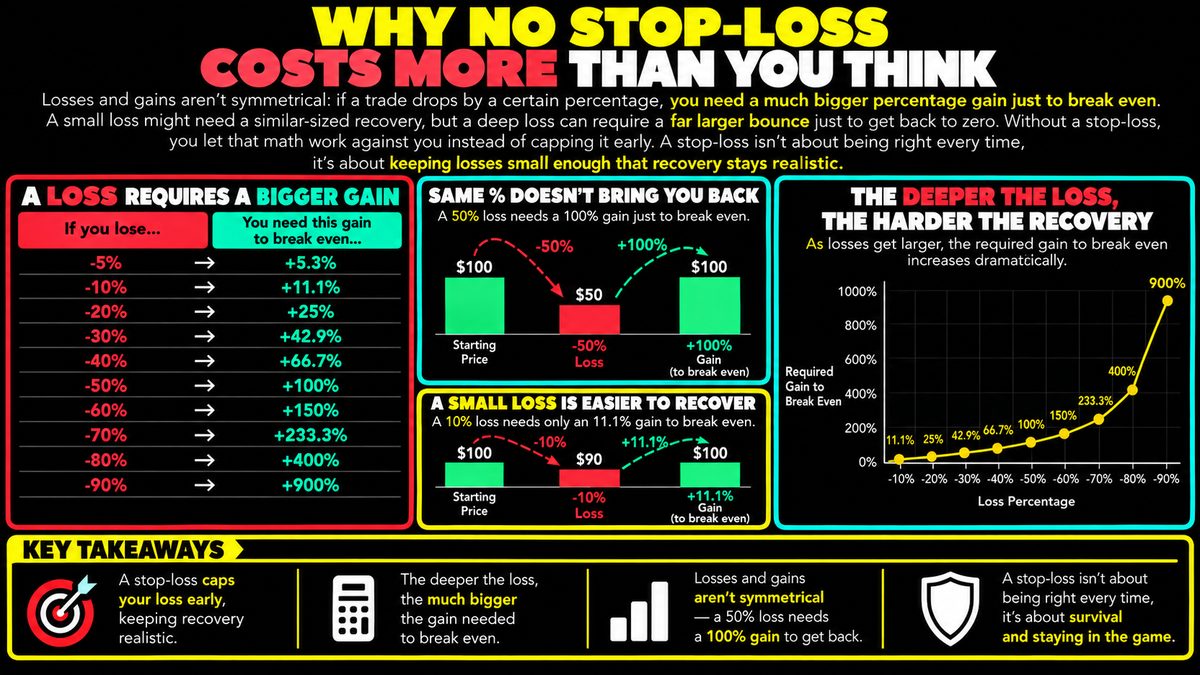
Losses and gains aren't symmetrical: if a trade drops by a certain percentage, you need a much bigger percentage gain just to break even. A small loss might need a similar-sized recovery, but a deep loss can require a far larger bounce just to get back to zero. Without a stop-loss, you let that math work against you instead of capping it early. A stop-loss isn't about being right every time, it's about keeping losses small enough that recovery stays realistic.
The Math Behind the Pain
Percentage losses and percentage gains are not mirror images of each other, even though it feels like they should be. If a position drops by 10 percent, you only need about 11 percent back to break even. That still feels fair. But if a position drops by 50 percent, you don't need 50 percent back, you need 100 percent, a full doubling, just to return to where you started. Drop 80 percent and you need a 400 percent gain to recover. This is simple arithmetic, not opinion, and it applies to every market, every asset, every trader.
The reason is that percentage losses shrink the base you're calculating future gains from. Imagine 100 units of value. Lose 50 percent and you have 50 units left. To get back to 100, that 50 needs to grow by 100 percent, not 50. The deeper the hole, the steeper the climb out, and the relationship is not linear, it accelerates.
Why This Matters More Than It Seems
Many traders intuitively understand this math in the abstract but ignore it in practice, because in the moment, a losing position doesn't feel like a math problem, it feels like a story. There's a common hope that if you just wait, the price will come back, since it got this low "for no good reason." But waiting without a plan means the loss can keep deepening while the required recovery keeps growing, quietly making the situation worse even if the price stays flat or drifts sideways for a while.
This asymmetry is also why a string of small losses is far easier to recover from than one large one. Ten losses of 3 percent each are painful but recoverable with modest gains. One loss of 50 percent can take a long stretch of otherwise good trading just to undo.
What a Stop-Loss Actually Does
A stop-loss is simply a predetermined point where you exit a trade if the price moves against you by a certain amount, set in advance rather than decided emotionally in the moment. It does not predict where the market will go, and it does not guarantee you'll avoid losses altogether. What it does is cap how deep a single loss can get, which keeps the recovery math on your side instead of against you.
Think of it less as an admission of being wrong and more as a budget for being wrong. Every trader is wrong sometimes. A stop-loss decides in advance how much that wrongness is allowed to cost.
Common Mistakes Around Stops
A frequent mistake is setting a stop-loss and then moving it further away once the price approaches it, hoping to avoid locking in a loss. This defeats the purpose entirely, since the whole value of a stop is that it's decided before emotions are involved. Another mistake is setting stops so tight that normal, harmless price wiggles trigger an exit before the trade ever had a chance to work. Finding a reasonable distance usually depends on the asset's typical volatility, not a fixed number that works everywhere.
Fitting Stops Into a Bigger Plan
A stop-loss works best alongside sensible position sizing, meaning you never risk so much on one trade that even a capped loss feels catastrophic. It's one tool among many, not a guarantee of success, and markets can gap or move fast enough that an exact stop price isn't always achievable. The goal is not perfection, it's keeping any single mistake small enough that staying in the game remains realistic.