
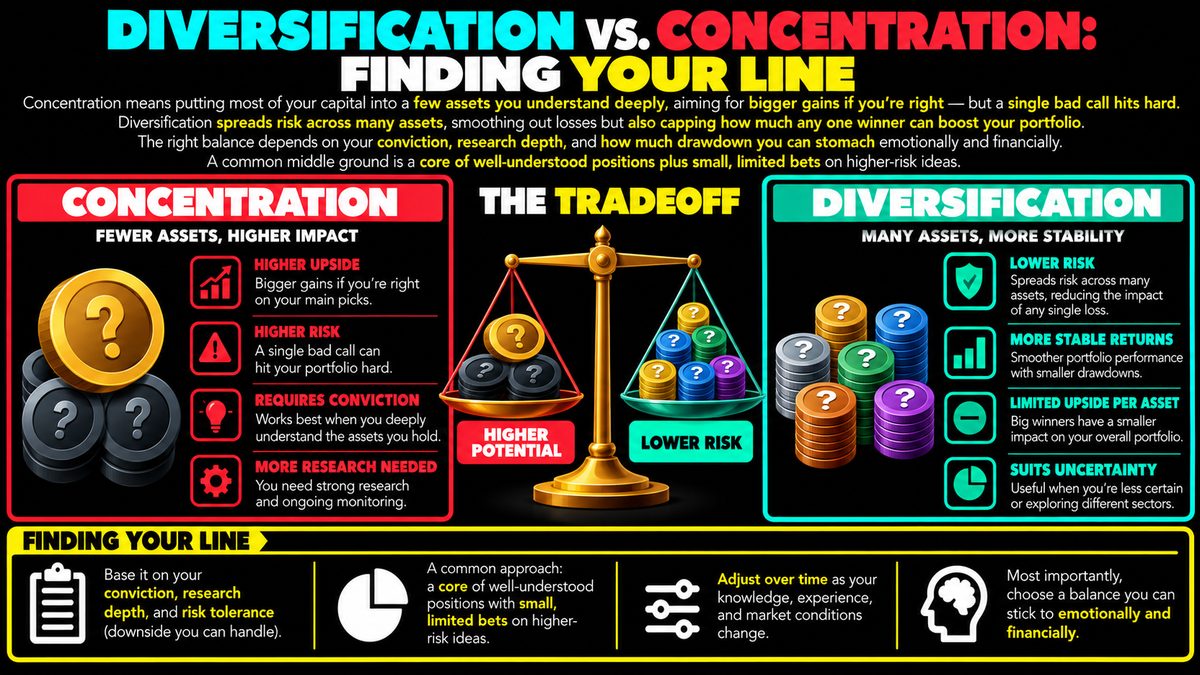
Concentration means putting most of your capital into a few assets you understand deeply, aiming for bigger gains if you're right — but a single bad call hits hard. Diversification spreads risk across many assets, smoothing out losses but also capping how much any one winner can boost your portfolio. The right balance depends on your conviction, research depth, and how much drawdown you can stomach emotionally and financially. A common middle ground is a core of well-understood positions plus small, limited bets on higher-risk ideas.
Why This Tradeoff Exists
Every portfolio decision involves choosing how much weight to give to any single idea. Concentration means putting a large share of your capital into a small number of assets, usually because you believe you understand them better than the market does. Diversification means spreading capital across many assets so that no single outcome defines your results. Neither approach is objectively correct. They represent different tradeoffs between potential upside and the size of a possible drawdown, which is the decline in value from a previous peak.
The reason this choice matters so much in crypto specifically is that individual coins can move dramatically in short periods, far more than most traditional assets. That volatility, meaning the degree of price fluctuation, amplifies the consequences of concentration in both directions. A concentrated position in something that performs well can meaningfully change a portfolio's trajectory. The same concentration in something that performs poorly can do comparable damage the other way.
What Concentration Offers and Costs
The appeal of concentration is straightforward. If you have done deep research into a small number of assets and genuinely understand their fundamentals, technology, or market position, putting meaningful capital behind that conviction lets your results actually reflect your research. Spreading that same capital across twenty assets you know little about dilutes the benefit of having done the work in the first place.
The cost is equally straightforward. Deep research reduces uncertainty but does not eliminate it. Markets react to factors outside any individual's control, including regulation, liquidity conditions, and broad sentiment shifts. A concentrated position that goes wrong can produce a drawdown large enough to be financially and emotionally difficult to recover from, sometimes prompting decisions made under stress rather than according to plan.
What Diversification Offers and Costs
Diversification works by reducing the chance that any one asset's bad outcome defines your overall result. If one holding performs poorly, others may perform differently, smoothing the combined outcome. This can make a portfolio easier to hold through volatile periods, since no single loss feels catastrophic.
The tradeoff is that diversification also caps how much a strong performer can lift the whole portfolio. If you hold fifty assets and one does exceptionally well, its impact on your total capital is limited by its small starting weight. Diversification also requires monitoring more positions, and spreading capital across assets you do not understand well is not the same as genuinely managing risk, it can simply be concentration in ignorance spread thin.
Finding a Personal Line
There is no formula that tells you the correct number of positions or the correct allocation percentage, because the right balance depends on factors specific to you. These include how deeply you have actually researched each asset, how much capital you can afford to see decline without altering your financial life, and how you tend to react emotionally to drawdowns, since a plan you cannot follow under stress is not a workable plan.
A commonly discussed middle ground involves holding a core of positions you understand reasonably well, sized larger because of that familiarity, alongside smaller allocations to higher-risk ideas that would not meaningfully damage the portfolio if they underperform. This structure is not a guarantee of better outcomes, since any asset, familiar or not, can move against expectations.
Combining This With Other Risk Tools
Position sizing decisions work alongside other risk practices rather than replacing them. Setting a maximum percentage of total capital you are willing to risk on any single idea, revisiting your reasoning for a position periodically, and avoiding decisions driven purely by recent price moves all complement whatever balance of concentration and diversification you choose. No allocation approach removes the underlying uncertainty of markets, it only changes how that uncertainty is distributed across your portfolio.