
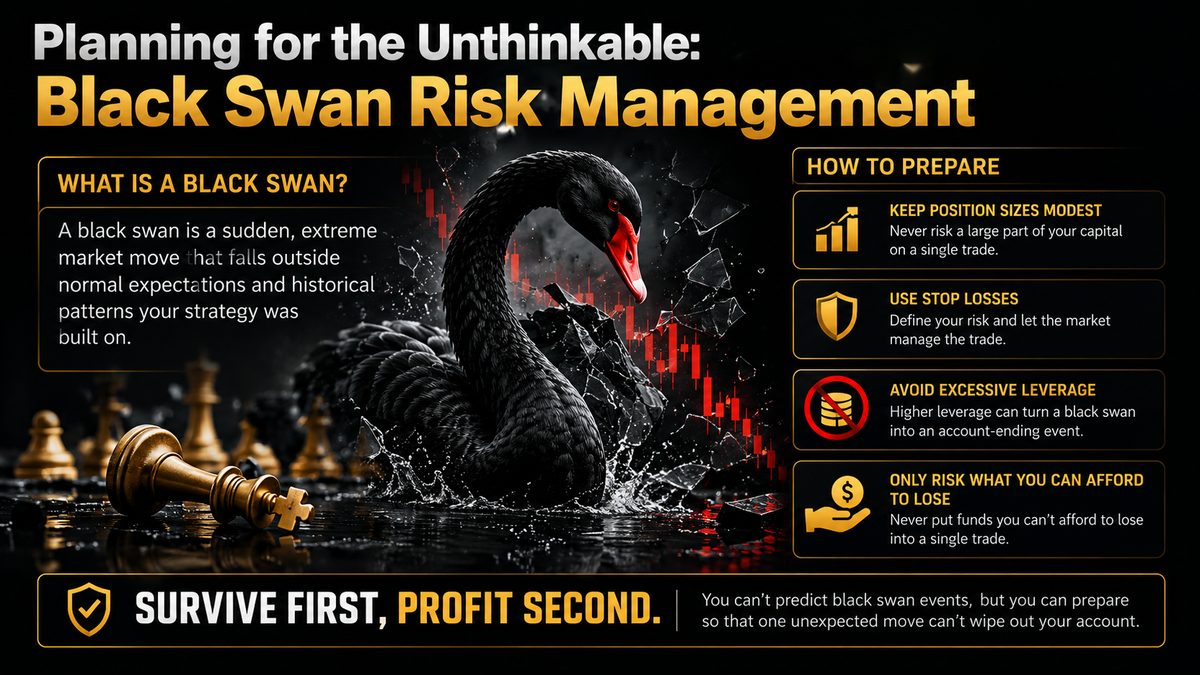
A black swan is a sudden, extreme market move that falls outside normal expectations and historical patterns your strategy was built on. You can't predict these events, but you can prepare for them by keeping position sizes modest, using stop losses, avoiding excessive leverage, and never putting funds you can't afford to lose into a single trade. The goal isn't forecasting chaos — it's making sure one unexpected event can't wipe out your account. A simple rule: survive first, profit second.
What a Black Swan Actually Is
A black swan is a term borrowed from finance writing to describe an event so rare and extreme that most people did not think it was possible until it happened. In crypto markets, this could mean a sudden crash, an unexpected regulatory shock, a technical failure, or some other surprise that causes prices to move far more violently than usual. The defining feature isn't just that the move is large, it's that it falls outside the range your strategy, backtests, or risk models assumed was realistic.
This matters because most trading systems are built using historical data and "normal" volatility assumptions. A black swan event breaks those assumptions entirely. It doesn't follow the usual chart patterns, doesn't respect typical support or resistance levels, and often happens faster than a trader can react manually.
Why You Cannot Predict It
By definition, black swans are not things you can forecast with indicators, chart patterns, or news analysis. If an event were predictable, it wouldn't be a black swan, it would just be a known risk. This is an important mental shift for traders: the goal is not to try to spot the next one in advance, because that is largely impossible. Instead, the goal is to build a trading approach that can survive one happening without warning, at any time, in either direction.
Trying to predict the unpredictable often leads to wasted energy or false confidence. A trader who believes they can always see disaster coming may take on more risk elsewhere, assuming they'll "get out in time." Black swans are precisely the events that don't give you time.
Position Sizing as Your First Defense
The simplest and most effective protection against a black swan is never risking so much on one trade or one position that a sudden adverse move could seriously damage your account. This is often described as position sizing. For example, imagine a trader decides no single trade will ever risk more than a small, fixed percentage of their total trading funds. If that trade goes wrong, even dramatically, the damage is contained and the trader can continue operating.
This approach doesn't prevent losses, it limits their size. It also removes the temptation to treat any one trade as a make-or-break moment, which tends to produce calmer, more rational decision-making overall.
Stop Losses and Leverage Discipline
A stop loss is an order that automatically closes a position once price reaches a certain level, intended to cap losses before they grow larger. While stop losses cannot guarantee protection during extreme volatility, since price can gap or move too fast for orders to fill at the expected level, they still represent a basic risk control that many traders consider essential.
Leverage, which means trading with borrowed funds to control a larger position than your own capital would normally allow, dramatically increases both potential gains and potential losses. During a black swan event, high leverage can turn a survivable move into a total loss very quickly. Keeping leverage low, or avoiding it entirely, gives a trader more room to absorb shocks.
Survive First, Profit Second
The core philosophy behind black swan preparation is simple, protecting your capital matters more than maximizing short-term gains. A trader who avoids catastrophic losses lives to trade another day, while a trader who is wiped out by one extreme event loses the ability to participate at all, regardless of how skilled they were beforehand.
No combination of stop losses, position sizing, or reduced leverage can guarantee safety from every possible extreme event. These tools reduce risk, they don't eliminate it. Treating them as part of a broader risk management mindset, rather than a guarantee, is what separates durable trading habits from false security.