
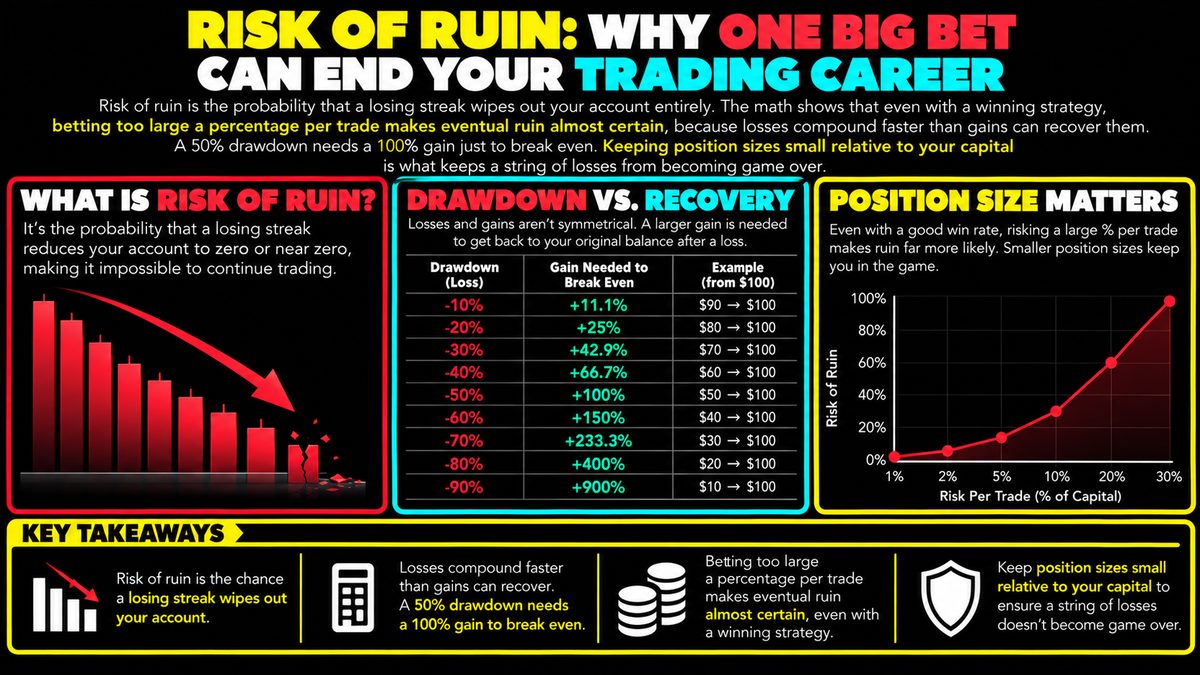
Risk of ruin is the probability that a losing streak wipes out your account entirely. The math shows that even with a winning strategy, betting too large a percentage per trade makes eventual ruin almost certain, because losses compound faster than gains can recover them. A 50% drawdown needs a 100% gain just to break even. Keeping position sizes small relative to your capital is what keeps a string of losses from becoming game over.
What Risk of Ruin Actually Means
Risk of ruin is a concept borrowed from gambling theory that describes the probability that a trader loses so much of their capital that they can no longer realistically continue trading. It is not about any single loss. It is about the mathematical chance that a sequence of losses, given your position sizing habits, eventually drains your account toward zero or some practical floor where recovery becomes impossible.
The key insight is that risk of ruin is not primarily about whether your trading strategy is profitable on average. Even a strategy with a genuine statistical edge, meaning it wins more often or wins bigger than it loses over a large number of trades, can still produce a high risk of ruin if each individual bet is too large relative to total capital. Edge and survival are two separate questions, and traders who only focus on the first one often get blindsided by the second.
The Math of Losses and Recoveries
The core problem is asymmetry between losses and the gains needed to recover from them. If an account drops by 10 percent, it takes roughly 11 percent gain to get back to even. If it drops by 50 percent, it takes a full 100 percent gain just to return to the starting point. If it drops by 90 percent, it takes a 900 percent gain. This relationship is not linear, it curves sharply against you as losses deepen.
This is why a string of losses is far more dangerous than it first appears. A trader who bets a large fixed percentage of their capital on every trade can hit a handful of losing trades in a row, something that happens naturally even to a sound strategy, and find themselves in a hole that is statistically very difficult to climb out of, no matter how good future trades are.
How Position Size Drives Risk of Ruin
Imagine two traders using the identical strategy, one risking 2 percent of their account per trade and another risking 25 percent. Over many trades, random losing streaks will occur for both. The trader risking 2 percent might see their account dip but remain intact and able to keep trading. The trader risking 25 percent can be functionally wiped out after only a few consecutive losses, even though both traders were using the same signals and same win rate.
This is the essence of why risk of ruin calculations exist. They show that the percentage risked per trade is often more decisive to long-term survival than the quality of the strategy itself. Small, consistent risk sizing creates room for the natural variance of trading outcomes to play out without catastrophic damage.
Common Mistakes and Limitations
A common mistake is increasing position size after a few wins, assuming confidence or a hot streak justifies it, only to give it all back plus more on the next losing streak. Another is ignoring correlation, holding several trades that are effectively the same bet in different disguises, which multiplies real risk beyond what position size alone suggests. Risk of ruin models also assume somewhat stable conditions and independent trades, which real markets do not always provide, so the numbers are a guide, not a guarantee.
Fitting It Into a Broader Risk Framework
Risk of ruin works best alongside other risk management habits such as diversification, predefined stop losses, and realistic expectations about win rates. No single rule prevents all losses, and no calculation can promise survival. But keeping individual trade risk small and consistent is one of the few things within a trader's direct control, which is why it remains a foundational idea rather than an optional afterthought.