
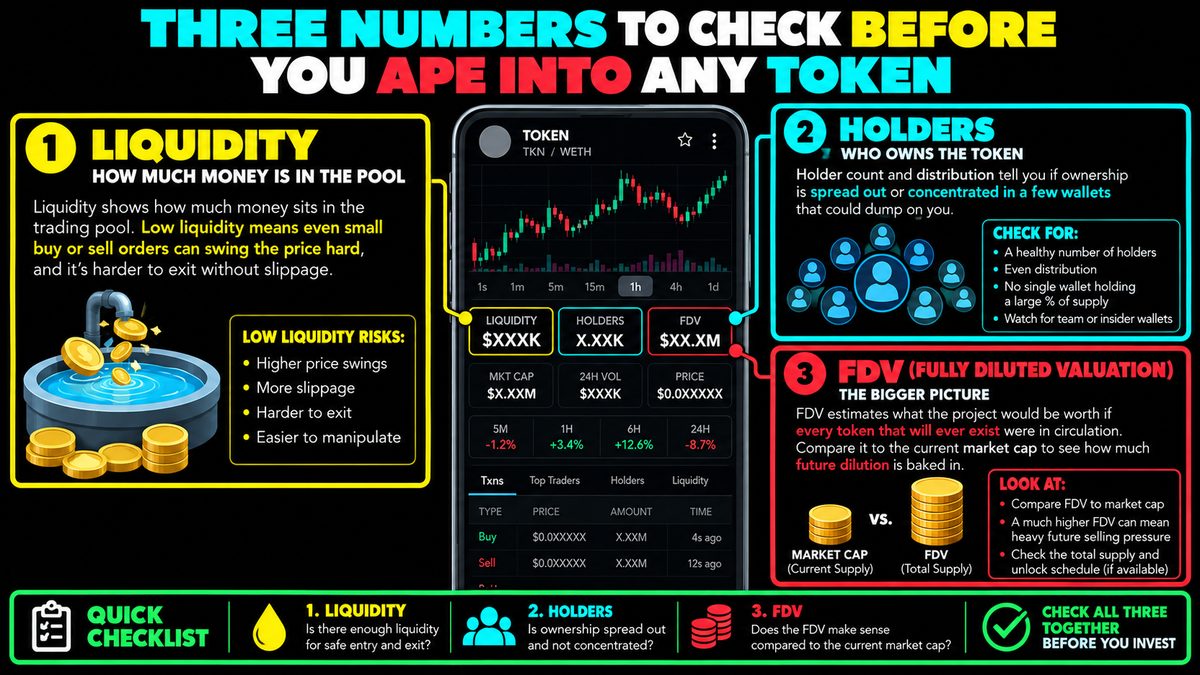
Liquidity shows how much money sits in the trading pool — low liquidity means even small buy or sell orders can swing the price hard, and it's harder to exit without slippage. Holder count and distribution tell you if ownership is spread out or concentrated in a few wallets that could dump on you. FDV, or fully diluted valuation, estimates what the project would be worth if every token that will ever exist were in circulation — compare it to the current market cap to see how much future dilution is baked in. Checking all three together gives a quick gut-check before you commit capital.
Why These Three Numbers Matter
Before putting money into any token, it helps to run a quick gut-check using three pieces of public data: liquidity, holder distribution, and fully diluted valuation. None of these numbers can tell you whether a token will go up or down. What they can do is flag structural risks that have nothing to do with the project's story or marketing, and everything to do with how the market for that token is actually built. Think of this as a pre-flight checklist, not a prediction tool.
Liquidity and Why Shallow Pools Are Risky
Liquidity refers to how much money sits in the trading pool that lets people buy and sell a token. Imagine a pool holding the equivalent of 10,000 in value on each side. A trade of just a few hundred could move the price noticeably, because there is not enough depth to absorb it. This price movement caused by your own order is called slippage, meaning you get a worse average price than you expected.
Low liquidity cuts both ways. It can make a token look like it is pumping on small buying volume, but it also means that when you want to exit, your own sell order might crash the price before you get out. As a rough habit, it helps to compare the size of the position you are considering against the size of the pool, rather than looking at your trade in isolation. A trade that is a tiny fraction of the pool behaves very differently from one that represents a large share of it.
Holder Count and Concentration
Holder count is simply how many distinct wallets hold a token, and distribution describes how evenly or unevenly that supply is spread among them. A token held by a wide base of thousands of wallets, none holding an outsized share, behaves differently from one where a handful of wallets control most of the supply.
Concentrated ownership matters because large holders, sometimes called whales, can sell a significant chunk at once, which can push the price down sharply regardless of liquidity depth. It is worth remembering that raw holder counts can be misleading too, since wallets can be split up or created cheaply, so a high number alone does not guarantee healthy distribution. Looking at what percentage of supply the top ten or twenty wallets hold, when that data is available, often gives a clearer picture than the headline holder count.
Fully Diluted Valuation Versus Market Cap
Market capitalization is the current circulating supply multiplied by the current price. Fully diluted valuation, or FDV, estimates what the total value would be if every token that will ever exist, including ones not yet released, were already in circulation at today's price.
A large gap between market cap and FDV suggests significant future dilution is baked in, meaning many more tokens are scheduled to enter circulation over time. That does not automatically make a token bad, since release schedules vary widely, but a wide gap is worth understanding before committing capital, since new supply entering the market can create ongoing sell pressure independent of anything else happening with the project.
Putting the Checklist Together
None of these three numbers works well in isolation, and all three have limitations, since on-chain data can be incomplete, manipulated, or simply hard to interpret without context. Treat this as one input alongside your own research and a clear risk management plan, such as deciding in advance how much you are willing to risk and sizing positions accordingly. No checklist, pattern, or indicator removes the underlying uncertainty of trading, and this guide is not financial advice.