
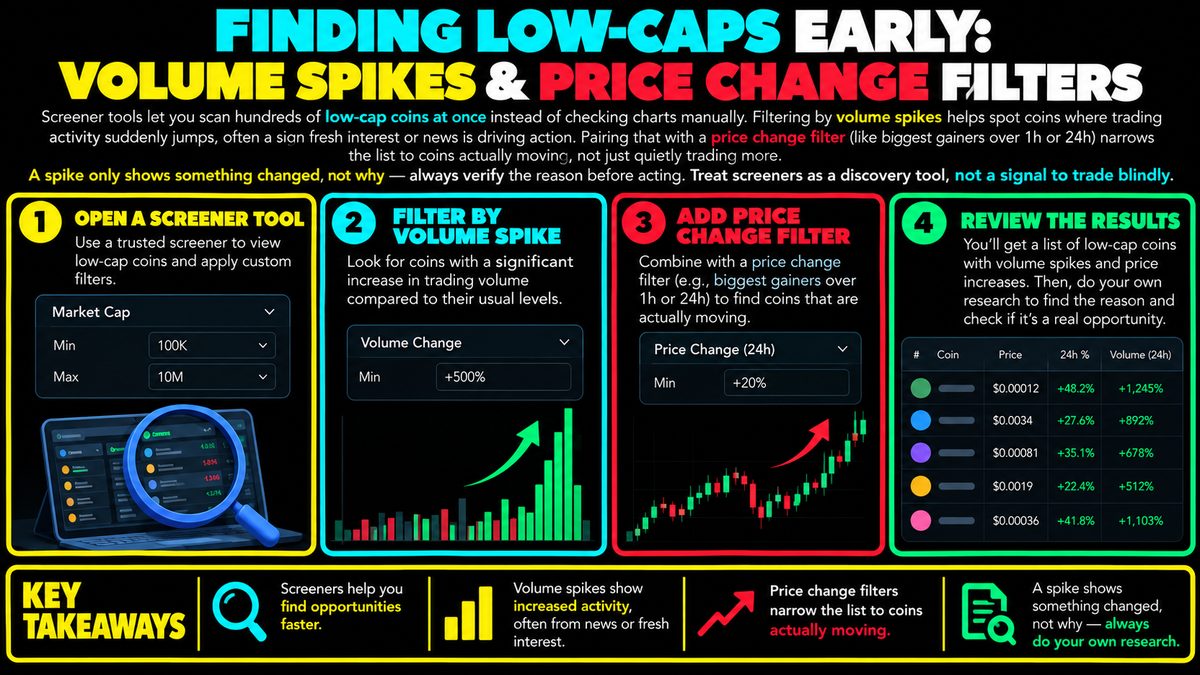
Screener tools let you scan hundreds of low-cap coins at once instead of checking charts manually. Filtering by volume spikes helps spot coins where trading activity suddenly jumps, often a sign fresh interest or news is driving action. Pairing that with a price change filter (like biggest gainers over 1h or 24h) narrows the list to coins actually moving, not just quietly trading more. Remember: a spike only shows something changed, not why — always verify the reason before acting. Treat screeners as a discovery tool, not a signal to trade blindly.
What A Screener Actually Does
A screener is simply a filtering tool that scans a large list of coins at once and shows you only the ones matching certain conditions you set, instead of you clicking through hundreds of charts one by one. Think of it like a search filter on a shopping site, except instead of filtering by price or brand, you are filtering by trading data such as volume, price change, or market capitalization. For low-cap coins, which are coins with a relatively small total market value and often thinner trading activity, screeners are especially useful because there are simply too many of them to track manually.
On its own, a screener does not predict anything. It only reorganizes existing data so patterns become easier to notice. The real value comes from how you set the filters and how you interpret what shows up.
Volume Spikes As A Starting Clue
Trading volume is the amount of a coin bought and sold over a given period. A volume spike means that amount suddenly jumped well above what is normal for that coin, which can suggest new attention, a piece of news, or a shift in sentiment. For low-cap coins, where daily volume is often small and quiet, a sudden spike tends to stand out more clearly than it would for a large, heavily traded coin.
A spike does not tell you whether the attention is positive or negative. Heavy selling produces a volume spike just as easily as heavy buying does. It also does not tell you whether the move is sustainable or a brief burst that fades within minutes. It is a flag worth investigating, not a conclusion.
Adding A Price Change Filter
Pairing volume filters with a price change filter, such as biggest gainers over the last hour or 24 hours, helps separate coins that are simply trading more from coins that are actually moving in price. A coin can see unusually high volume while its price barely shifts, for example if a large holder is quietly splitting trades, or if buyers and sellers are roughly balanced. Combining both filters narrows a long list down to coins where increased activity is coinciding with a real price reaction, which is generally more interesting to look into further.
Even then, a gainers list reflects what already happened, not what will happen next. A coin at the top of a 1 hour gainers list can just as easily reverse in the following hour.
Why The Reason Still Matters
A screener will never tell you why something is happening. The jump could come from genuine news, a listing announcement, a social media post, coordinated buying, or simply a low liquidity coin where a modest order moves the price a lot. Liquidity refers to how easily a coin can be bought or sold without significantly affecting its price, and low-cap coins often have thin liquidity, meaning small amounts of money can create outsized swings.
Before treating any flagged coin as worth deeper research, it is worth checking what is actually being said about it, how deep its order book or liquidity looks, and whether the move is backed by broad participation or just a handful of trades.
Common Mistakes And Sensible Limits
A frequent mistake is treating a screener result as a signal to act immediately, rather than as a shortlist to investigate. Another is ignoring how easily low-cap prices can be manipulated with relatively little capital, which means spikes can be engineered rather than organic. Relying on a single filter combination also creates blind spots, since different time frames and thresholds surface different coins.
Screeners work best alongside other research habits, such as checking a project's background, reading price action in context, and applying firm risk management like never risking more than you can afford to lose. No filter, spike, or indicator guarantees an outcome, and past activity never assures future results.