
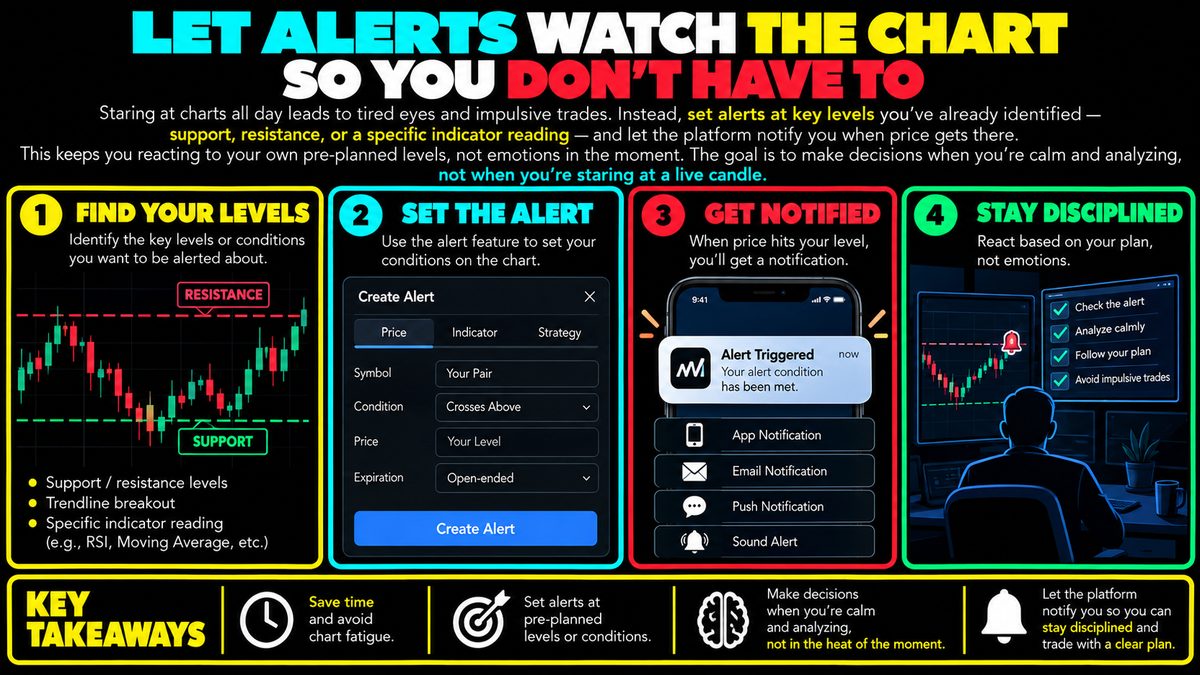
Staring at charts all day leads to tired eyes and impulsive trades. Instead, set alerts at key levels you've already identified — support, resistance, or a specific indicator reading — and let the platform notify you when price gets there. This keeps you reacting to your own pre-planned levels, not emotions in the moment. The goal is to make decisions when you're calm and analyzing, not when you're staring at a live candle.
Why Constant Watching Backfires
When you stare at a live chart for hours, every small wiggle in price starts to feel important. This is partly a psychological effect: the human brain is wired to react to movement and change, even when that movement is meaningless noise. Over time, this constant visual stimulation leads to decision fatigue, where your judgment quietly gets worse the longer you watch, even though you feel just as sharp as when you started. The result is often impulsive trades taken not because the setup changed, but because you simply couldn't resist acting after staring at a candle for too long.
Alerts solve this by separating the moment of analysis from the moment of action. You do your thinking in advance, calmly, and then let the platform do the watching. When the alert fires, you are reacting to a plan you already made, not to a feeling that built up while you watched the screen.
What Alerts Actually Are
An alert is simply a notification set to trigger when price, or some indicator value, reaches a level you choose in advance. Most charting tools and trading platforms let you set a price alert for a specific number, or a condition alert tied to an indicator, like a moving average crossing another line, or an oscillator entering a particular zone. Support and resistance are common reference points for alerts. Support is a price area where buying pressure has previously been strong enough to stop a decline, and resistance is an area where selling pressure has previously stopped a rally. Neither is a guaranteed wall, just a zone where price has reacted before.
Setting Alerts at Levels That Matter
The value of an alert depends entirely on the quality of the level behind it. Setting an alert at a level you picked without analysis is no better than watching the chart randomly. A more useful approach is to mark levels during a calm research session, looking at where price has reversed or paused multiple times in the past, or where a specific indicator reading has historically coincided with your strategy's entry or exit criteria. For example, you might set an alert near a prior swing high, a round psychological number, or a point where a moving average sits, simply as a hypothetical illustration of the idea, not a prediction of what will happen next.
Turning a Trigger Into a Decision
An alert firing is not a signal to act automatically. It is an invitation to look again, with fresh eyes, at whether the original reason for marking that level still holds. Conditions change between when you set an alert and when it triggers, so treat the notification as the start of a short analysis, not the end of one. This pause is what keeps you in control rather than letting the alert itself become a new source of impulsive reaction.
Limitations and Fitting Alerts Into a Plan
Alerts cannot tell you why price reached a level, only that it did. They do not account for sudden news, broader market shifts, or changes in volume and volatility, so they work best alongside other tools like trend analysis, volume checks, and a clear risk management plan that defines position size and acceptable loss before you ever place a trade. No alert, indicator, or chart pattern guarantees a specific outcome, and relying on any single tool without a broader framework can create a false sense of precision. Used thoughtfully, alerts are simply a way to protect your attention and your emotional state, letting you make decisions when you are calm rather than when you are staring at a moving line.