
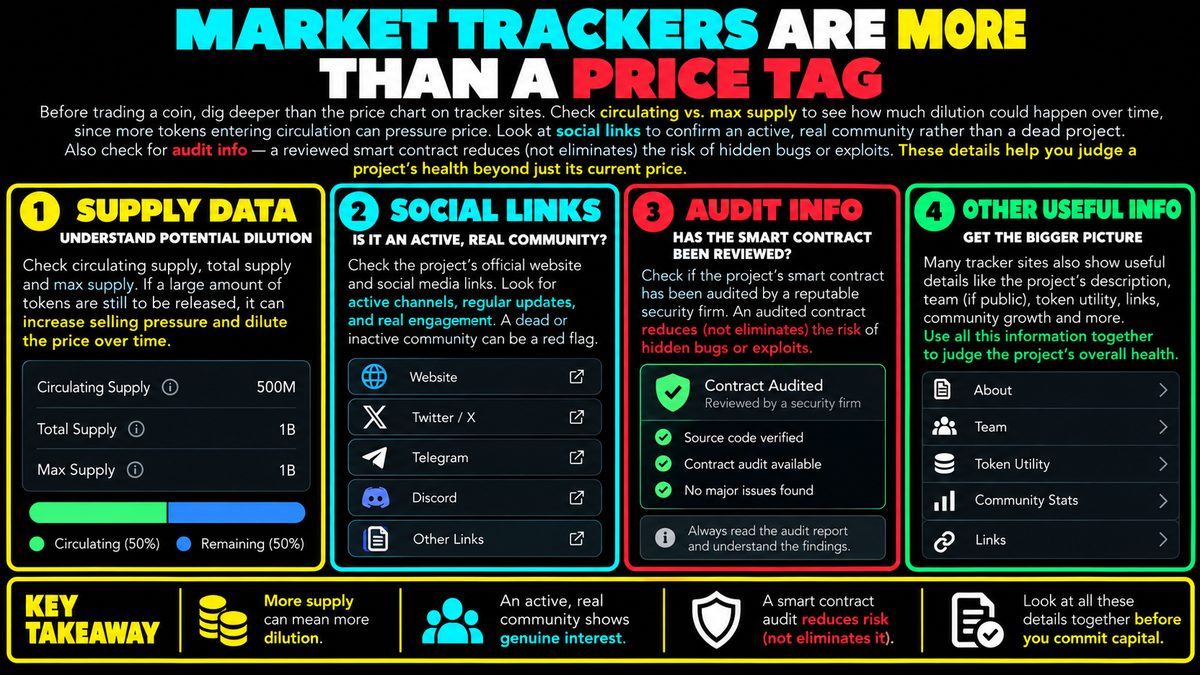
Before trading a coin, dig deeper than the price chart on tracker sites. Check circulating vs. max supply to see how much dilution could happen over time, since more tokens entering circulation can pressure price. Look at social links to confirm an active, real community rather than a dead project. Also check for audit info — a reviewed smart contract reduces (not eliminates) the risk of hidden bugs or exploits. These details help you judge a project's health beyond just its current price.
Why The Price Chart Isn't The Whole Story
A market tracker's price chart tells you what has already happened to a coin's value, but it says very little about why that happened or what might shape its future. Many beginners open a tracker, see a chart moving up and to the right, and treat that alone as a reason to get interested. In reality, a price chart is just one data point among many that a tracker usually displays, and the other fields often matter just as much for understanding a project's condition.
Circulating Supply Versus Max Supply
Circulating supply is the number of coins currently available and trading in the market. Max supply, when it exists, is the total number of coins that will ever be created. The gap between these two numbers matters because new coins entering circulation, often through scheduled unlocks, mining, or staking rewards, add to the available supply. If demand does not grow at the same pace as supply, this added supply can create downward pressure on price, a concept often called dilution.
Imagine a hypothetical coin with 10 million coins circulating today but a max supply of 100 million. That means up to 90 million more coins could eventually enter the market. Knowing this helps you think about long-term dilution risk rather than reacting only to today's price. It is not a prediction of what will happen, just a factor worth weighing alongside everything else.
Checking For A Real, Active Community
Most trackers list links to a project's social channels, websites, or community forums. These links are worth checking because an active, engaged community can be a sign that real people are using, discussing, or building around a project, while a silent or abandoned page can be a warning sign of a dead or low-activity project. Look for genuine discussion, recent updates, and responses from people who seem to understand the project, rather than channels filled only with price speculation or repetitive promotional posts.
This kind of check is not foolproof. Activity can be manufactured, and quiet communities do not always mean a project has failed. It is simply one more piece of context to weigh rather than a guarantee of legitimacy.
What Smart Contract Audits Actually Tell You
For projects built on smart contracts, many trackers show whether the project's code has been audited. An audit means independent reviewers examined the contract's code looking for bugs, vulnerabilities, or design flaws that could be exploited. A completed audit can lower the risk of certain technical failures, such as a flaw that lets someone drain funds from the contract.
It is important to understand what an audit does not do. It does not guarantee the project is safe, profitable, or free of all risk, and it does not evaluate whether the business or community behind it is trustworthy. Audits can also vary widely in depth and quality depending on who performed them. Treat an audit as a reduction in one specific kind of risk, not a seal of total safety.
Putting The Pieces Together With Risk Management
None of these details, supply figures, community activity, or audit status, work well in isolation. They are most useful when combined with your own research habits and sound risk management, such as only committing money you can afford to lose and avoiding concentrating everything into a single project. A coin can look appealing on a price chart while carrying heavy dilution risk, a lifeless community, or no audit at all.
Market trackers give you the raw ingredients to ask better questions, not final answers. No combination of supply data, social signals, or audit badges can guarantee a project's future performance, and no amount of research removes the underlying uncertainty of crypto markets. Reading beyond the price tag simply helps you make more informed, deliberate decisions.