
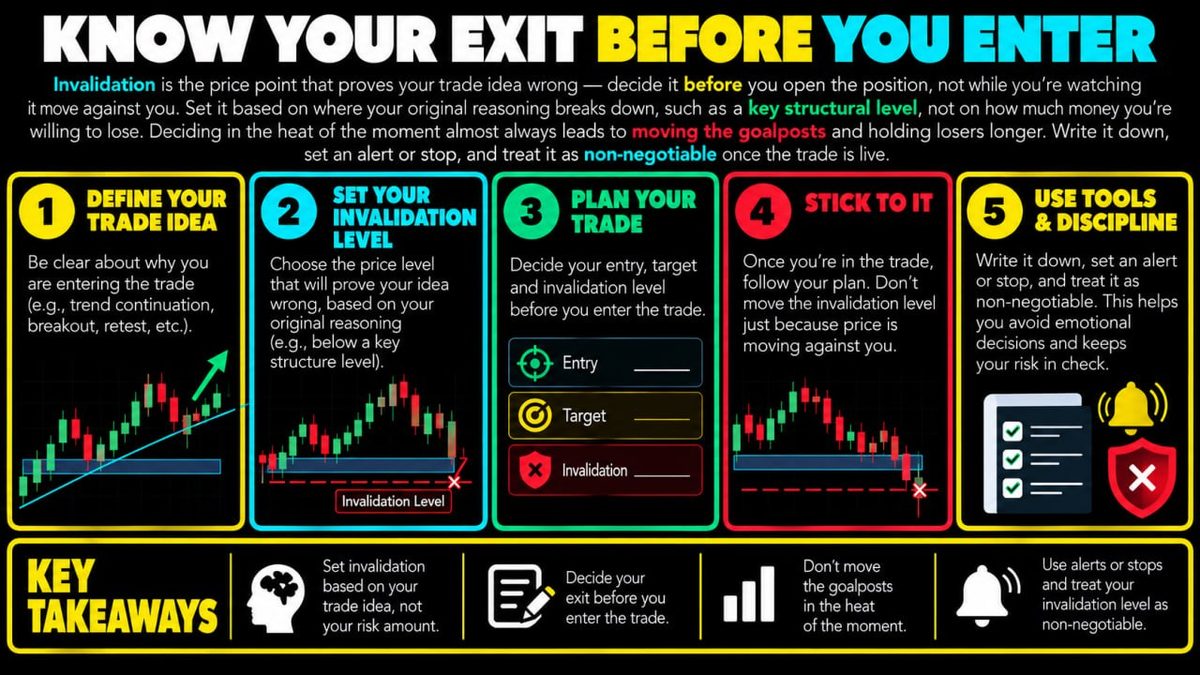
Invalidation is the price point that proves your trade idea wrong — decide it before you open the position, not while you're watching it move against you. Set it based on where your original reasoning breaks down, such as a key structural level, not on how much money you're willing to lose. Deciding in the heat of the moment almost always leads to moving the goalposts and holding losers longer. Write it down, set an alert or stop, and treat it as non-negotiable once the trade is live.
What Invalidation Actually Means
Every trade starts with a reason. Maybe you believe a coin is holding above a level that has acted as support, where buying pressure has repeatedly outweighed selling pressure, or that a trend of higher highs and higher lows is still intact. Invalidation is simply the price point where that reason stops being true. It is not a feeling, and it is not a number you pick because it feels safe. It is the spot where, if price reaches it, your original idea is proven wrong by the market itself.
This distinction matters because many traders confuse invalidation with "how much I'm willing to lose." Those are two different questions. One is about risk tolerance, the other is about whether your analysis still holds. When you blend them together, you end up placing exits based on emotion or account size rather than on what the chart or your reasoning actually says.
Why It Has To Be Set Before Entry
Deciding your exit while a trade is already open, especially while it is moving against you, puts you in the worst possible mental state to make a clear decision. Watching an open position lose value triggers stress responses that push people toward hope rather than logic. Hypothetically, a trader might buy near 100 expecting a support zone around 95 to hold, but once price dips to 96, the temptation is to tell themselves "it'll probably bounce from 90 instead." That is moving the goalposts, and it almost always leads to holding losing trades far longer than planned, turning a small, defined loss into a much larger one.
Setting invalidation beforehand removes that negotiation entirely. You are no longer deciding in real time whether to accept a loss. You already decided, back when you were calm and objective, exactly what would prove the trade wrong.
How Traders Typically Define It
Invalidation is usually tied to structure rather than arbitrary percentages. That could mean a prior swing low or high, a trendline break, a key moving average, or the boundary of a range the asset has been trading in. The common thread is that these levels represent a meaningful shift in the balance between buyers and sellers, not just a round number that feels comfortable.
Because it's based on structure, invalidation will naturally vary in distance from your entry depending on the setup. This is a normal part of trading and is one reason position sizing, deciding how much of your capital to risk on a given trade, is a separate step that happens after invalidation is identified, not before.
Making It Stick
Once a level is chosen, write it down along with the reasoning behind it. Many traders also set a price alert or an actual stop order, an instruction that closes the position automatically if price reaches a certain level, so the decision isn't left to willpower in a stressful moment. Treating that level as non-negotiable once the trade is live is the entire point of the exercise.
Limitations Worth Remembering
No invalidation level, pattern, or indicator guarantees anything. Prices can move past a level briefly before reversing, markets can gap, and liquidity, meaning how easily an asset can be bought or sold without moving its price, can vary. Invalidation is a tool for managing uncertainty and keeping decisions consistent, not a way to predict outcomes. It works best alongside broader risk management practices, not as a replacement for them, and nothing here should be read as a signal to open or close any specific position.