
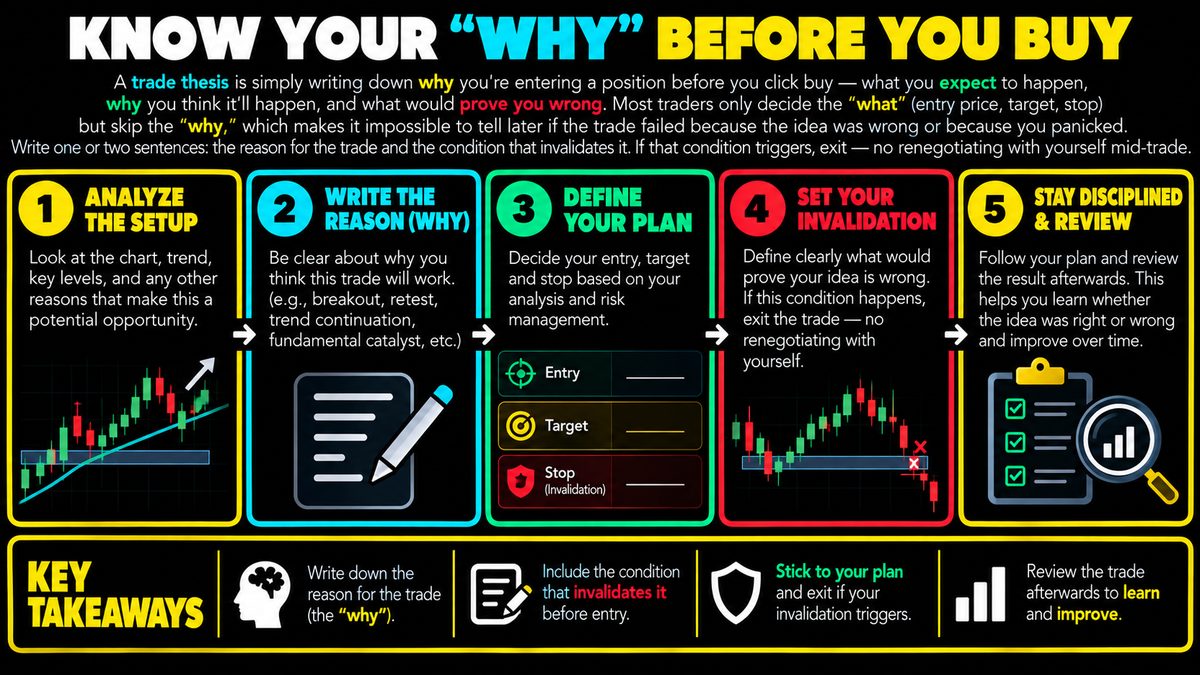
A trade thesis is simply writing down why you're entering a position before you click buy — what you expect to happen, why you think it'll happen, and what would prove you wrong. Most traders only decide the "what" (entry price, target, stop) but skip the "why," which makes it impossible to tell later if the trade failed because the idea was wrong or because you panicked. Write one or two sentences: the reason for the trade and the condition that invalidates it. If that condition triggers, exit — no renegotiating with yourself mid-trade.
What a Trade Thesis Actually Is
A trade thesis is a short written statement that explains why you are entering a position, what you expect to happen, and what specific event would prove that idea wrong. It is not a prediction about where price will go, and it is not a feeling of excitement about a coin. It is a simple sentence or two that forces you to put your reasoning into words before you commit money. If you cannot explain your reasoning in plain language, that itself is useful information, because it usually means the trade is based on impulse rather than logic.
Most beginner traders focus entirely on the mechanics of a trade: entry price, target price, stop-loss level. Those numbers matter, but they only describe the "what." The thesis is the "why" behind those numbers, and without it, the numbers are arbitrary.
Why the "Why" Matters More Than the "What"
Imagine two traders both buy a coin at 100 expecting it to reach 120. One of them bought because "it felt like it was about to pump." The other bought because they believed a specific condition, such as a pattern breaking out or a piece of news changing sentiment, would push buyers in. If the price instead drops to 90, only the second trader can clearly judge whether their original reasoning failed or whether they simply got shaken out by normal volatility.
Without a written thesis, every losing trade becomes ambiguous. You cannot tell if the idea itself was flawed or if you abandoned a good idea too early out of fear. Over time, this ambiguity prevents learning, because you never build a clear record of which types of reasoning actually tend to work for you.
Writing an Invalidation Condition
The second half of a thesis is just as important as the first: the condition that proves you wrong. This should be a specific, observable event, not a vague feeling. For example, "I expect this coin to hold support around 100 because buyers have stepped in near this level before; if it closes clearly below 95, my idea is wrong." That invalidation condition becomes your stop-loss logic, not an arbitrary number picked for comfort.
The discipline here is that once the invalidation condition triggers, you exit. There is no renegotiating with yourself, no moving the line further away because "it might still bounce." If you keep changing the condition after the fact, the thesis loses its entire purpose, because it stops being a test of your idea and becomes a way to avoid admitting the idea failed.
Common Mistakes Traders Make
A frequent error is writing a thesis so vague that nothing could ever invalidate it, such as "this coin looks strong." That statement cannot be proven wrong, so it provides no discipline. Another mistake is confusing hope with reasoning, for example entering because a trade is "due" for a bounce with no actual evidence supporting that view. A thesis should describe a condition you can observe in the market, not a hope about what the market should do for you.
Fitting This Into Risk Management
A trade thesis works alongside, not instead of, basic risk management such as position sizing and stop-losses. It does not guarantee a trade will work, and no written reasoning can remove uncertainty from markets. What it does is give you a consistent, honest way to review decisions afterward, separating bad luck from bad reasoning, and separating discipline from panic.