
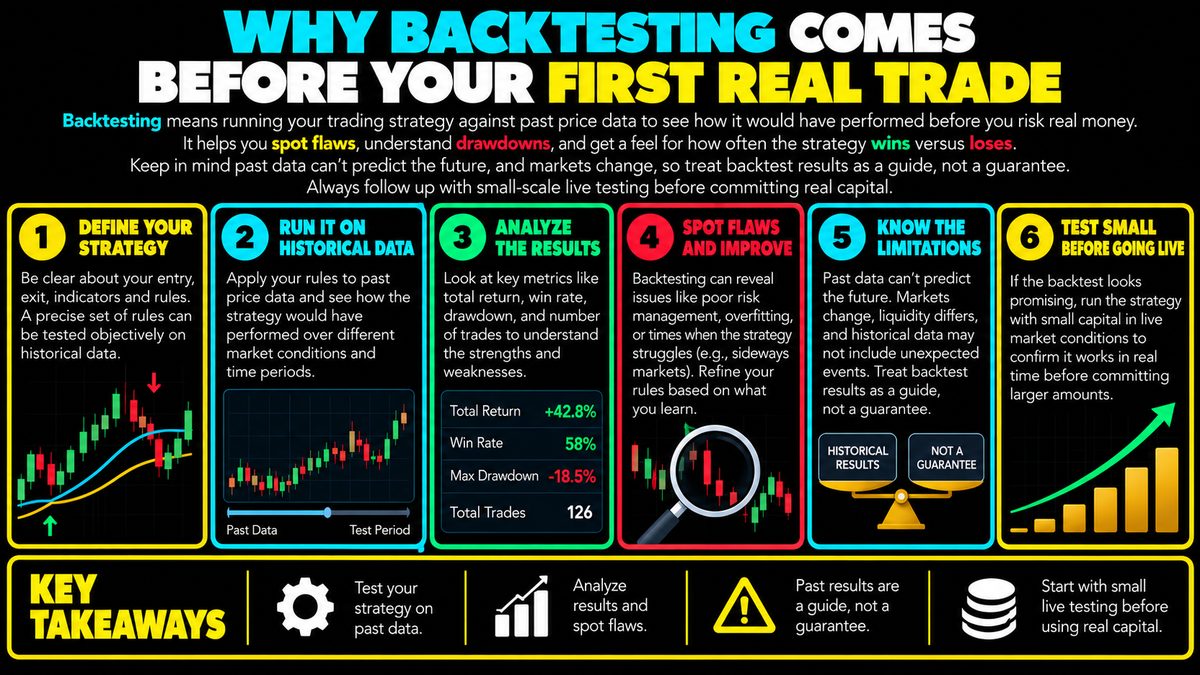
Backtesting means running your trading strategy against past price data to see how it would have performed before you risk real money. It helps you spot flaws, understand drawdowns, and get a feel for how often the strategy wins versus loses. Keep in mind past data can't predict the future, and markets change, so treat backtest results as a guide, not a guarantee. Always follow up with small-scale live testing before committing real capital.
What Backtesting Actually Is
Backtesting is the process of taking a trading strategy with clear, written rules and applying those rules to historical price data to see what would have happened if you had traded it in the past. Instead of guessing whether an idea might work, you simulate it across weeks, months, or years of past market movement. The output is not a promise of future results, but a record of how the strategy behaved under real historical conditions, including the good stretches and the painful ones.
A strategy, for backtesting purposes, needs to be specific enough to apply mechanically. "Buy when it looks strong" is not testable. "Buy when a short-term moving average crosses above a longer-term moving average, and sell when it crosses back below" is testable, because anyone running it on the same data would reach the same trades. Vague ideas have to be turned into rules before they can be evaluated at all.
How a Backtest Gets Built
The basic process involves choosing a market and timeframe, defining entry and exit rules, deciding on position sizing, and then stepping through historical price data candle by candle or day by day, recording every simulated trade the rules would have triggered. From those trades you can calculate things like win rate, which is the percentage of trades that were profitable, and drawdown, which is the largest peak-to-trough decline the account would have experienced during the test period.
Drawdown matters because it shows the emotional and financial pain a strategy can inflict even if it is profitable overall. A strategy that ends up positive after a year but spends three months deeply underwater along the way is a very different experience to actually trade than one with a smoother equity curve, even if the final numbers look similar on paper.
Why Traders Rely on It
The main value of backtesting is catching flaws before they cost real money. A strategy might sound reasonable in theory but turn out to lose consistently during sideways markets, or rely on a lucky run of trades that inflates its apparent performance. Seeing this in a backtest, where mistakes only cost time, is far cheaper than discovering it with real capital on the line.
Backtesting also builds familiarity. Watching how a strategy performs across dozens or hundreds of simulated trades helps a trader understand its rhythm: how often it wins, how long losing streaks typically run, and what a normal drawdown looks like versus an abnormal one. That familiarity can reduce panic decisions later, because the trader has already seen similar patterns play out.
Where Backtests Mislead People
Historical data reflects conditions that existed at the time, and markets evolve. Volatility levels, trading volume, and the behavior of other participants can shift, so a rule set that worked well in one period may struggle in another. There is also a common trap called overfitting, where a strategy is tweaked repeatedly until it matches past data almost perfectly, but those exact tweaks happen to only work because they were fitted to that specific history, not because they capture anything reliable about how markets behave.
Backtests also tend to understate real-world friction. Trading fees, slippage, which is the difference between the expected execution price and the actual one, and the emotional difficulty of following rules in real time are easy to underweight in a spreadsheet simulation.
Moving from Backtest to Real Trading
Because of these limitations, a backtest should be treated as a filter, not a finish line. A strategy that performs poorly in testing is unlikely to be worth trading live. One that performs well deserves a next step, not immediate full-size commitment.
That next step is small-scale live testing, sometimes called forward testing, where the same rules are applied with real but minimal capital in current market conditions. This checks whether the strategy still behaves as expected outside of historical data and whether the trader can actually follow its rules under real pressure. Only after that stage does it make sense to consider larger position sizes, and even then, ongoing risk management and realistic expectations remain essential, since no amount of testing removes uncertainty from markets.