
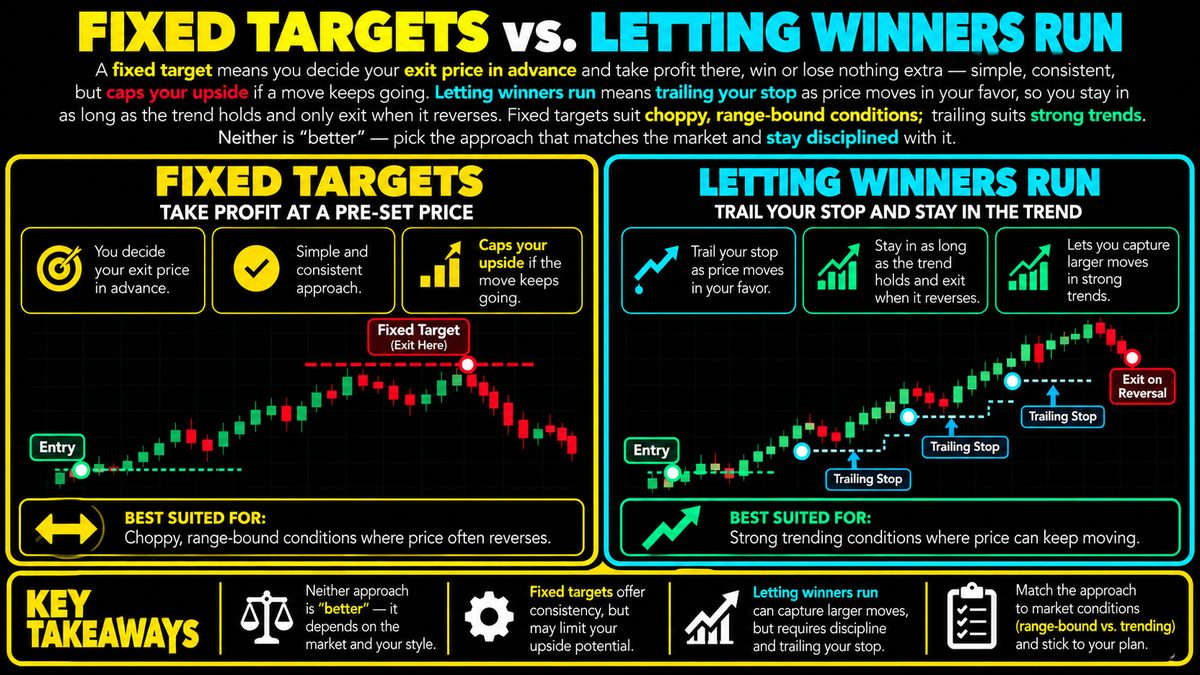
A fixed target means you decide your exit price in advance and take profit there, win or lose nothing extra — simple, consistent, but caps your upside if a move keeps going. Letting winners run means trailing your stop as price moves in your favor, so you stay in as long as the trend holds and only exit when it reverses. Fixed targets suit choppy, range-bound conditions; trailing suits strong trends. Neither is "better" — pick the approach that matches the market and stay disciplined with it.
Two Philosophies of Exiting a Trade
Every trade eventually needs an exit, and how you choose that exit shapes your results as much as your entry does. Two common approaches sit at opposite ends of a spectrum. One is the fixed target, where you decide in advance exactly where you will take profit and stick to it regardless of what happens afterward. The other is letting winners run, where you avoid picking a specific price and instead adjust your stop loss (the price at which you exit to limit losses) as the trade moves in your favor, staying in until the trend actually turns against you. Neither method is right or wrong on its own; they simply suit different market conditions and different trader temperaments.
How Fixed Targets Work
A fixed target is set before you even enter the trade. Imagine buying a coin at 100 and deciding your exit is 110, a round ten percent gain. Once price reaches that level, you close the position, whether the market keeps climbing afterward or reverses immediately. This approach is simple and removes emotion from the exit decision, since there is nothing to debate once the price is hit. It tends to work well in choppy or range-bound markets, where price oscillates between levels rather than trending strongly in one direction, because it captures gains before a reversal erases them. The tradeoff is obvious: if the market breaks out into a bigger move, a fixed target leaves potential profit on the table.
How Trailing Stops Work
Letting winners run usually means using a trailing stop, a stop loss that moves up as price moves in your favor but never moves back down. Using the same hypothetical, if you buy at 100 and price rises to 120, you might move your stop from below 100 up to, say, 110, locking in some gain while still allowing room for the trade to continue. If the trend keeps going, the stop keeps following it. You only exit when price actually reverses and hits the trailing stop. This approach suits strong trending conditions, where a move can run much further than an initial target might assume, but it requires patience and tolerance for giving back some open profit before the stop is triggered.
Matching the Method to the Market
The core tension is that fixed targets protect you from giving back gains in a choppy market, while trailing stops let you capture more of a sustained trend. The challenge is that nobody knows in advance which kind of market is unfolding. Some traders look at recent price behavior, volatility, or broader context to guess whether conditions favor ranging or trending, but this is always an estimate, not a certainty. Markets can shift from one regime to another without warning, turning a reasonable plan into a poor fit after the fact.
Common Mistakes and Limitations
A frequent mistake is switching strategies mid-trade, abandoning a fixed target because price looks like it might keep running, or abandoning a trailing stop because a small pullback feels uncomfortable. This inconsistency often produces worse outcomes than sticking with either method. Another limitation is that trailing stops can still get hit by normal volatility before a real trend reversal, and fixed targets can close a position just before a larger move begins. Neither method predicts the future or guarantees profit.
Fitting Into a Broader Trading Plan
Whichever approach you choose, it works best as part of a complete plan that includes position sizing, a predetermined stop loss, and awareness of overall risk. Deciding your exit philosophy before entering a trade, and applying it consistently across many trades, matters more than finding a perfect method. Over time, discipline in execution tends to matter more than which specific exit style you prefer.