
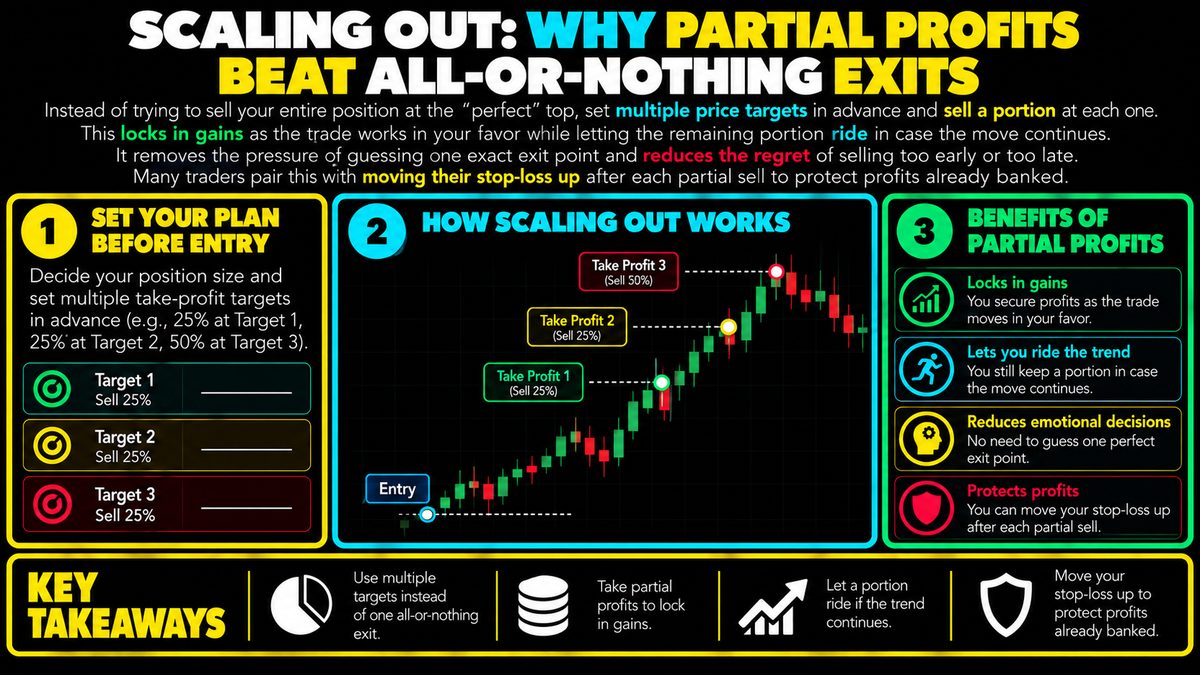
Instead of trying to sell your entire position at the "perfect" top, set multiple price targets in advance and sell a portion at each one. This locks in gains as the trade works in your favor while letting the remaining portion ride in case the move continues. It removes the pressure of guessing one exact exit point and reduces the regret of selling too early or too late. Many traders pair this with moving their stop-loss up after each partial sell to protect profits already banked.
What Scaling Out Actually Means
Scaling out is the practice of closing a position in stages rather than all at once. Instead of placing a single sell order at one target price, a trader divides their position into portions, say three or four equal slices, and assigns each slice a different price level to exit at. As the price moves favorably and hits each level, a portion of the position is sold, while the rest continues to be held.
The core idea is simple: nobody can consistently know in advance exactly where a price move will end. By spreading exits across multiple levels, a trader avoids betting everything on guessing one precise top or bottom.
How It Works In Practice
Imagine a trader buys a coin at 100 with a plan to scale out. They might decide to sell a third of the position at 110, another third at 120, and let the final third ride with a trailing stop in case the price keeps climbing toward 140 or beyond. Each target is set based on the trader's own analysis, whether that is support and resistance levels, a risk-to-reward ratio, or a predefined percentage gain.
A common companion technique is adjusting the stop-loss, which is a predetermined price at which the remaining position is automatically sold to limit losses, upward after each partial exit. For example, once the first slice is sold at a profit, the stop-loss on the remaining portion might be moved up to the original entry price. This way, even if the market reverses sharply, the trade cannot turn into a net loss on the capital still in play.
Why Traders Use This Approach
The main appeal of scaling out is psychological as much as it is tactical. Trying to sell an entire position at the single best possible price creates enormous pressure and often leads to hesitation, second-guessing, or selling too early out of fear and too late out of greed. Breaking the exit into stages removes that binary decision. A trader locks in some profit early, which reduces anxiety, while still participating if the trend continues further than expected.
It also smooths out the impact of volatility. Markets rarely move in a straight line, and a position sold entirely at one point may miss a better price shortly after, or get caught in a reversal that erases unrealized gains. Scaling out spreads that risk across several outcomes rather than concentrating it in one decision.
Common Mistakes And Limitations
Scaling out is not a guarantee of better results and it does not eliminate risk. One common mistake is setting targets too close together, which results in selling most of the position almost immediately and missing larger moves. Another is failing to actually follow the plan, moving targets further away mid-trade out of greed once the price approaches them, which defeats the purpose of having predefined levels.
It is also worth remembering that scaling out can sometimes mean an overall lower average exit price compared with holding for one lucky top, or conversely a worse outcome if the market reverses sharply right after the first exit. No sequence of partial sells can predict future price action.
Fitting It Into A Broader Strategy
Scaling out works best as one part of a complete trading plan that includes position sizing, a clear invalidation point for the trade, and realistic expectations about volatility. It pairs naturally with trailing stops and with technical levels like support and resistance, but it is a risk management technique, not a forecasting tool. Like any method, it should be tested and adjusted to fit individual risk tolerance rather than treated as a guaranteed formula for success.