
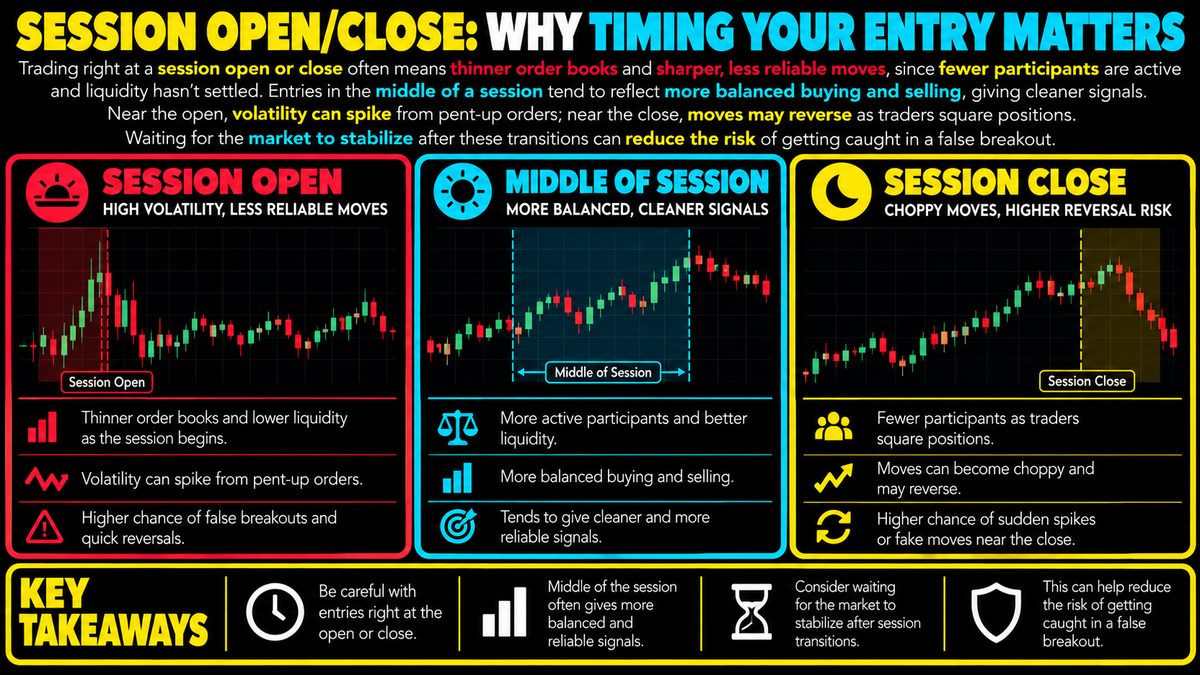
Trading right at a session open or close often means thinner order books and sharper, less reliable moves, since fewer participants are active and liquidity hasn't settled. Entries in the middle of a session tend to reflect more balanced buying and selling, giving cleaner signals. Near the open, volatility can spike from pent-up orders; near the close, moves may reverse as traders square positions. Waiting for the market to stabilize after these transitions can reduce the risk of getting caught in a false breakout.
What a Trading Session Actually Is
Crypto markets trade around the clock, but trading activity still ebbs and flows in patterns that resemble the opening and closing hours of traditional markets in different regions. A session can refer to a specific stretch of hours when a particular region's traders are most active, such as a rough approximation of Asian, European, or American trading hours. Because crypto never fully closes, these "sessions" are softer and less official than in stock markets, but the underlying idea still matters: participation rises and falls in waves throughout the day.
Order books, which list the current buy and sell orders waiting to be filled at various prices, tend to be thinner right at the edges of these sessions. Thin means there are fewer orders stacked up, so a single large trade can move the price more than it would during a busier period. This is the core reason timing an entry around session open or close carries extra risk.
Why Opens and Closes Get Choppy
At a session open, traders who have been waiting on the sidelines often place orders in a short burst, sometimes reacting to news or price action that built up while they were inactive. This pent-up order flow can cause a sharp, fast move that looks like the start of a strong trend but may just be a temporary imbalance working itself out. Once the initial rush fades, the price can drift back toward where it started.
Near a session close, something similar happens in reverse. Traders who opened positions earlier may rush to lock in profits, cut losses, or reduce exposure before reduced participation sets in. This squaring of positions can create sudden reversals that have little to do with new information and everything to do with people closing out trades at the same time.
Reading the Middle of a Session Differently
Once a session has been running for a while, order flow tends to reflect a broader mix of participants with different timeframes and opinions, rather than a single wave of orders hitting at once. This generally produces steadier price action, where moves are more likely to reflect an actual shift in buying or selling pressure rather than a temporary liquidity gap. Some traders prefer to observe how price behaves in the first portion of a session before deciding whether a move looks genuine, treating that early period as information rather than an immediate signal to act.
Common Mistakes Around Timing
One frequent mistake is reacting immediately to a sharp move at the open and assuming it will continue, without checking whether the move holds once more participants join. Another is misreading a late-session reversal as a trend change when it may simply be routine position squaring. Traders sometimes also apply this concept rigidly, assuming every open or close will behave the same way, when actual market conditions vary by day and by the broader environment.
Fitting This Into a Broader Approach
Session timing is a contextual factor, not a standalone signal, and it works best combined with other tools such as volume analysis, support and resistance levels, or broader trend context. It should never replace basic risk management practices like position sizing and stop-loss planning, since no pattern, including session timing, guarantees a particular outcome. Being aware of when liquidity is thin simply helps explain why certain moves happen and encourages a more patient, context-aware approach to entries.