
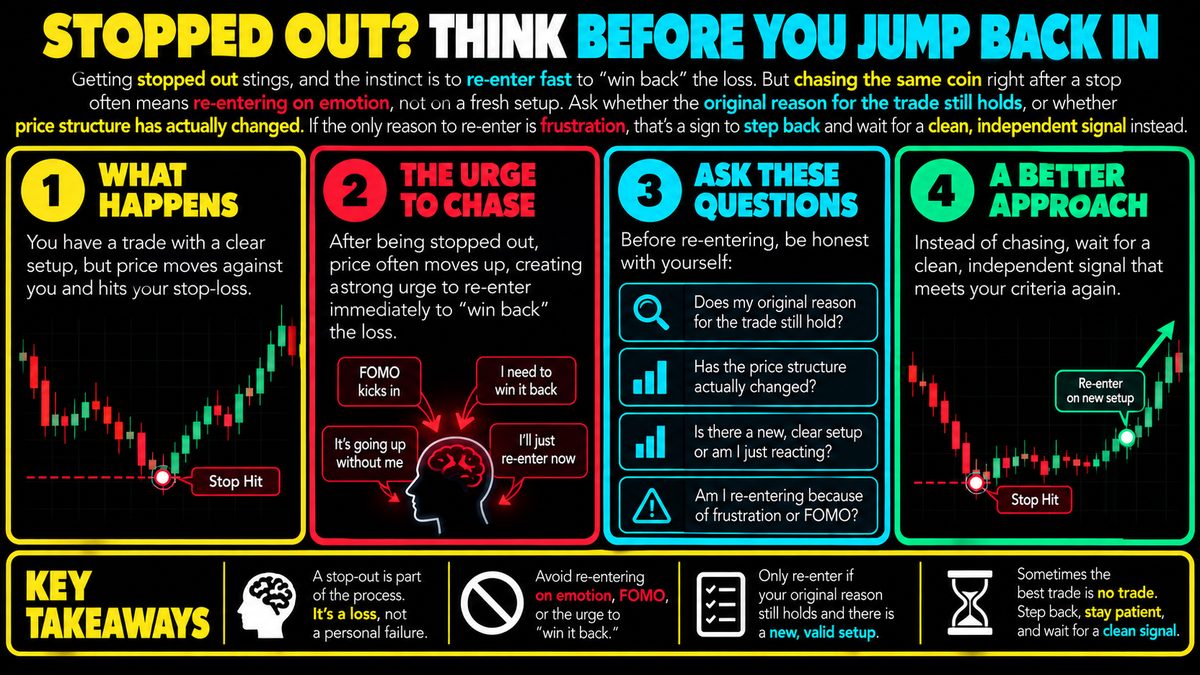
Getting stopped out stings, and the instinct is to re-enter fast to "win back" the loss. But chasing the same coin right after a stop often means re-entering on emotion, not on a fresh setup. Ask whether the original reason for the trade still holds, or whether price structure has actually changed. If the only reason to re-enter is frustration, that's a sign to step back and wait for a clean, independent signal instead.
What Happens When a Stop Gets Hit
A stop loss order is a pre-set instruction to exit a trade automatically once price moves against you to a certain level. It exists to cap losses before they grow larger than you planned for. When that stop triggers, the trade is closed, the loss is realized, and in many traders' minds a kind of alarm goes off. That alarm is not just financial, it is emotional. The brain tends to treat a loss as unfinished business, something to be corrected quickly rather than accepted and studied.
This is where trouble often begins. The instinct to jump straight back into the same coin, at roughly the same level, hoping to recover the loss immediately, is extremely common and extremely risky. It is driven by a psychological pattern sometimes called loss aversion, where the pain of losing feels stronger than the pleasure of an equivalent gain. That pain pushes people toward fast action, even when fast action is not supported by any real market signal.
Revenge Trading and Why It Feels Logical
Re-entering quickly after a stop is often called revenge trading, because the motivation is to get even with the market rather than to follow a strategy. In the moment it can feel perfectly reasonable. The price is right there, close to where you just exited, and it is tempting to believe the move was just a shakeout, a brief dip designed to trigger stops before the real move happens. Sometimes that is true. Often it is simply the market continuing in the direction that stopped you out in the first place.
The core problem is sequencing. A good trade idea is built on a reason, such as a specific chart pattern, a level of support or resistance, or a particular combination of indicators lining up. Revenge entries usually skip that process. The reason for re-entering is the loss itself, not a new, independent read of the market.
Ask If the Original Setup Still Holds
Before re-entering anything, it helps to separate two very different questions. One is, do I want to get back in because I am frustrated. The other is, has the actual market structure changed in a way that creates a fresh, valid setup. Imagine a hypothetical coin trading near 100 that you expected to bounce off support, and instead it broke down to 95 and stopped you out. If the only thing that happened is the stop was hit, the setup has not improved, it has arguably weakened.
A genuinely new signal would involve new information, such as price reclaiming a level it lost, a change in volume, or a different pattern forming on a higher timeframe. If none of that exists and the chart looks essentially the same as it did right before the stop, there is no fresh edge, only an emotional pull.
Building a Pause Into Your Process
One practical habit is to require a short waiting period or a specific checklist after any stopped-out trade, before considering the same asset again. This could mean stepping away for a set amount of time, writing down the original reason for the trade and comparing it honestly to current conditions, or requiring confirmation from a second, unrelated indicator before re-entering.
This pause is not about avoiding all re-entries. Sometimes the original thesis genuinely remains intact and a second attempt is reasonable. The goal is simply to make sure the decision comes from analysis rather than adrenaline.
Risk Management Still Comes First
No pattern, indicator, or rule of thumb removes uncertainty from trading. Stops will sometimes trigger right before a move goes the original direction, and other times they will correctly protect you from a larger loss. Either outcome is a normal part of using risk management, not proof that the method is wrong.
Keeping position sizes small relative to your overall capital, accepting that losses are a routine cost of participating in markets, and treating each entry as its own independent decision are all more reliable habits than chasing any single trade's outcome.