
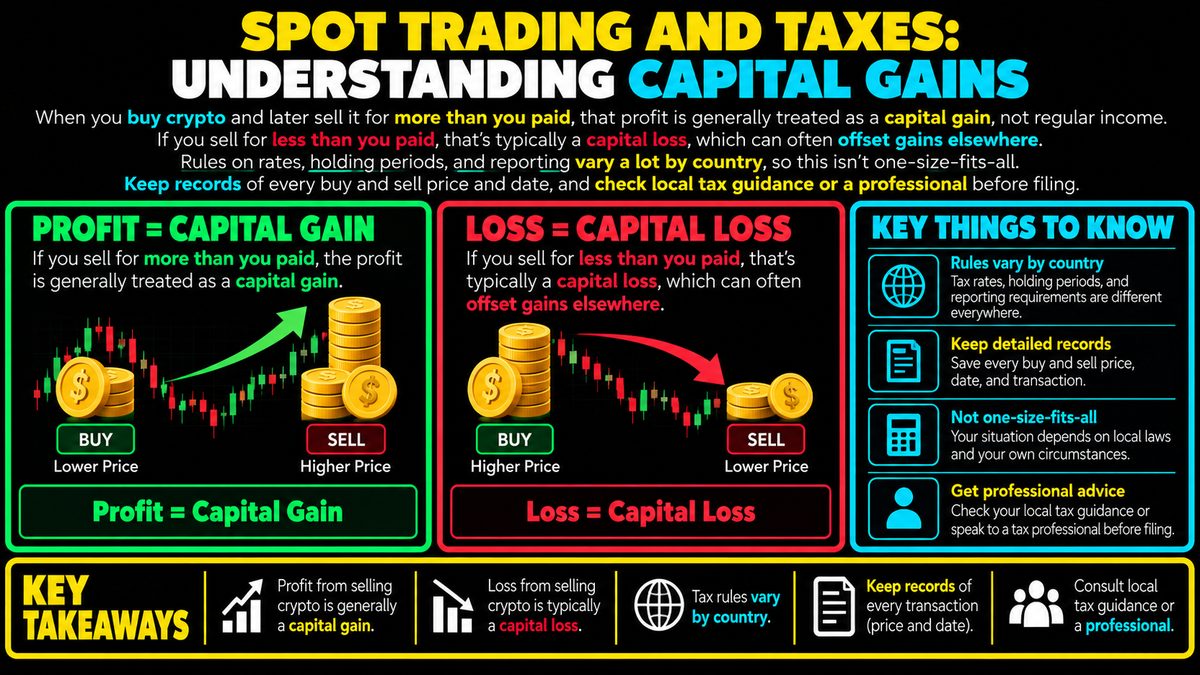
When you buy crypto and later sell it for more than you paid, that profit is generally treated as a capital gain, not regular income. If you sell for less than you paid, that's typically a capital loss, which can often offset gains elsewhere. Rules on rates, holding periods, and reporting vary a lot by country, so this isn't one-size-fits-all. Keep records of every buy and sell price and date, and check local tax guidance or a professional before filing.
What Counts as a Capital Gain
Spot trading means buying an asset outright and owning it directly, as opposed to using derivatives like futures or options. When you spot-buy a crypto asset and later sell it for more than you paid, the difference is usually classified as a capital gain in most tax systems. If you sell for less than your purchase price, that difference is usually a capital loss. The core idea is simple: gain or loss equals what you received when you sold, minus what you originally paid to acquire the asset, often called your cost basis. Fees paid to buy or sell can sometimes be added into that cost basis or subtracted from proceeds, depending on local rules, which changes the final number slightly.
Why Holding Period and Jurisdiction Matter
Many countries distinguish between short-term and long-term gains, where assets held beyond a certain threshold before selling may be taxed differently, sometimes at a lower rate. Other jurisdictions tax all gains the same way regardless of how long you held the asset, and some have no capital gains tax on crypto at all for individuals, while others treat frequent trading as business income rather than capital gains. Because these rules differ so much from one country to another, and sometimes even within regions of the same country, there is no universal formula that applies to everyone. What applies to a trader in one place may not apply at all somewhere else, so generic rules of thumb can be misleading.
How Losses Can Offset Gains
A useful feature of most capital gains systems is that losses are not just bad news on paper, they can often be used to reduce the tax owed on gains made elsewhere, sometimes in the same tax year and sometimes carried forward to future years. This is sometimes referred to as tax-loss harvesting, where a trader intentionally realizes a loss on a losing position to offset a gain on a winning one. The specific mechanics, limits, and whether this is even permitted vary by jurisdiction, and some places have special rules preventing you from immediately repurchasing the same asset after selling it at a loss purely for tax purposes.
Why Every Transaction Needs a Record
Because capital gains calculations depend on knowing exactly what you paid and what you received for every single trade, keeping detailed records is essential rather than optional. This includes the date of each buy and sell, the price and quantity involved, any fees paid, and ideally the asset's value in your local currency at the time of the transaction if you traded one crypto asset for another. Swapping one coin for another is often itself a taxable event in many systems, even if no local currency ever changed hands, which surprises many beginners. Without organized records, reconstructing a full trading history later, especially after many small trades, can become extremely difficult and error-prone.
Common Mistakes and Practical Limits
A frequent mistake is assuming that only cashing out to a bank account triggers taxes, when trading between crypto assets can also count as a disposal event in many places. Another common error is ignoring small trades, assuming they are too minor to matter, when tax authorities may still expect them reported. It is also a mistake to assume one country's rules apply universally, or that an online explainer like this one can substitute for official guidance in your specific location. Tax treatment of crypto is still evolving in many places, rules can change, and enforcement approaches differ. Nothing here constitutes financial or tax advice, and checking current local regulations or speaking with a qualified tax professional before filing is the only reliable way to handle your specific situation correctly.