
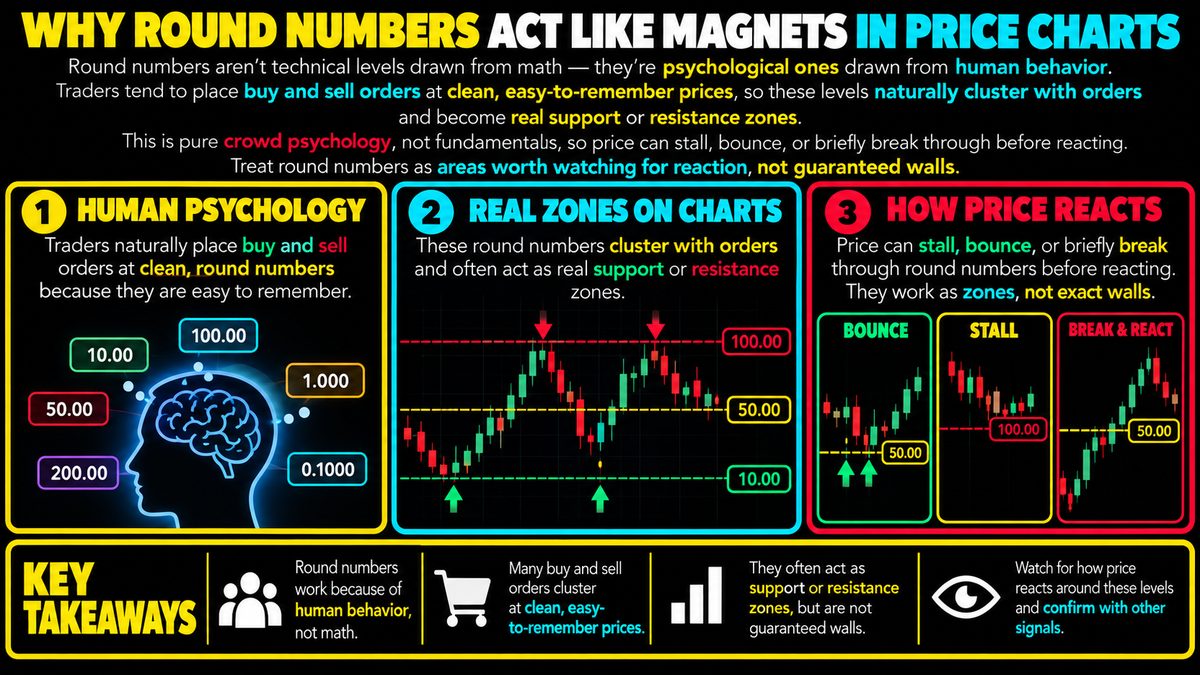
Round numbers aren't technical levels drawn from math — they're psychological ones drawn from human behavior. Traders tend to place buy and sell orders at clean, easy-to-remember prices, so these levels naturally cluster with orders and become real support or resistance zones. This is pure crowd psychology, not fundamentals, so price can stall, bounce, or briefly break through before reacting. Treat round numbers as areas worth watching for reaction, not guaranteed walls.
The Psychology Behind Clean Numbers
Humans like simplicity. When someone decides where to buy or sell an asset, it is much easier to type in a clean figure like 100 or 50,000 than something precise like 98.37 or 50,412. This has nothing to do with mathematics or the underlying project. It is a quirk of how our brains process information: round numbers are easier to remember, easier to set alerts around, and easier to talk about with other traders. Over time, this small individual habit, repeated across thousands of market participants, creates visible patterns on the chart.
How Orders Cluster Around These Levels
Support and resistance are just names for price zones where buying or selling pressure has historically shown up. A support zone is where demand has tended to absorb selling, slowing or reversing a decline. A resistance zone is where supply has tended to overwhelm buying, slowing or reversing a rally. Because so many traders place limit orders, stop-losses, and take-profit targets at round numbers, these levels naturally accumulate a larger pool of orders than the surrounding price area. When price approaches, it starts interacting with this denser cluster, which can cause hesitation, a bounce, or a brief pause before continuing.
Why Price Often Stalls or Fakes Out
Because these levels are psychological rather than structural, the reaction near them is rarely clean. Price might approach a round number, hover there for a while as orders get filled, then either reverse or punch through. Sometimes price will briefly poke above or below the level, triggering stop-losses on both sides, before snapping back. Traders call this a false break or a stop hunt, though it is simply a natural result of a crowded order zone rather than any deliberate conspiracy. Treating a round number as a guaranteed wall that price cannot cross is a common and costly mistake, since markets have no obligation to respect any level, round or otherwise.
Using Round Numbers Alongside Other Tools
Round numbers work best as an added layer of context rather than a standalone signal. A trader might combine a round number with a prior swing high or low, a trendline, or a moving average to see whether multiple forms of analysis line up in the same area. When several independent signals converge near the same price, that zone becomes more interesting to watch, though still not a certainty. Volume, which shows how much trading activity occurred at a given price, can also help gauge whether a round number is attracting genuine interest or just passing through quietly.
Common Mistakes and Realistic Expectations
A frequent error is assuming round numbers always hold or always break, and trading with excessive size based on that assumption alone. Another is ignoring the broader trend or market condition, since a round number in a strong uptrend may barely slow price down, while the same number in a quiet, range-bound market might cause a sharper reaction. It also helps to remember that round numbers exist at every scale, from whole units down to smaller increments, so not every one of them carries equal weight.
Putting It Into Practice Responsibly
Round numbers are a useful lens for understanding crowd behavior, not a forecasting tool. They can help a trader anticipate where reactions are more likely and plan risk management accordingly, such as where a stop-loss might make sense or where a position size should be adjusted. No pattern, including this one, guarantees an outcome, and relying on any single concept without proper risk control exposes a trader to unnecessary losses. Used thoughtfully, alongside other analysis and sound position sizing, round numbers simply add one more piece of context to a much larger picture.