
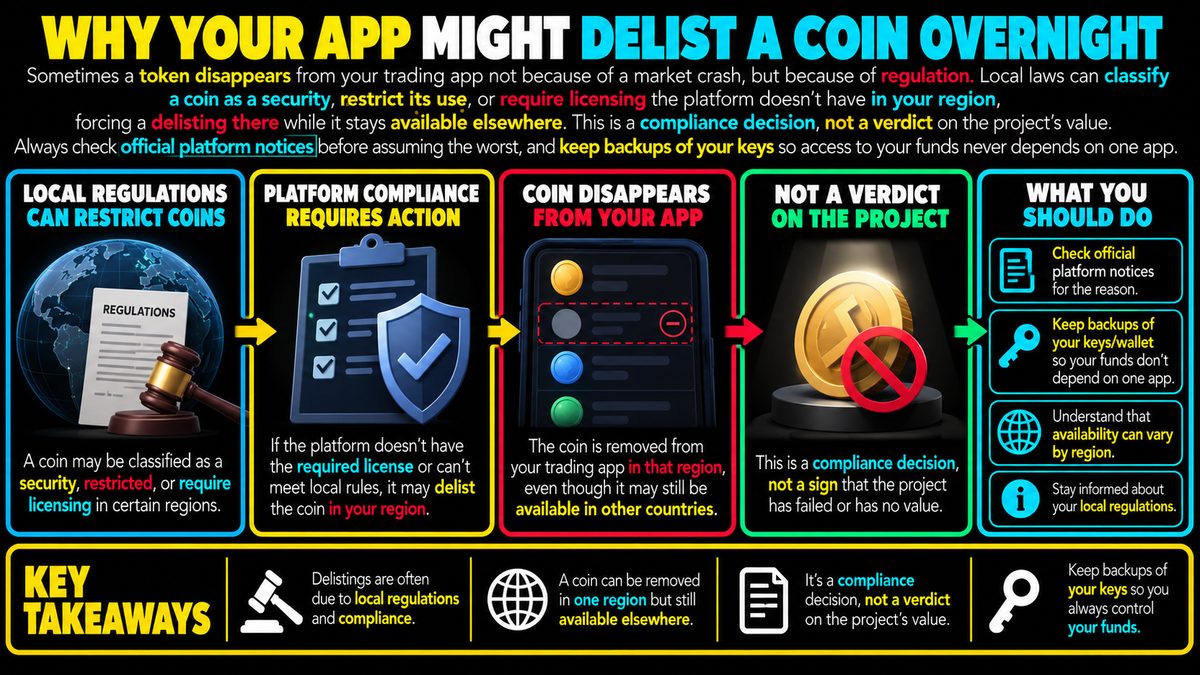
Sometimes a token disappears from your trading app not because of a market crash, but because of regulation. Local laws can classify a coin as a security, restrict its use, or require licensing the platform doesn't have in your region, forcing a delisting there while it stays available elsewhere. This is a compliance decision, not a verdict on the project's value. Always check official platform notices before assuming the worst, and keep backups of your keys so access to your funds never depends on one app.
What Delisting Actually Means
When a trading app removes a coin, it usually means the platform has stopped offering buying, selling, or sometimes even withdrawing that asset through its interface. This is different from the coin itself failing or the underlying project shutting down. The token can keep trading on other platforms, keep being developed, and keep having real users, even while one particular app no longer lists it. Delisting is a decision made by a business about what it offers, not a technical event affecting the blockchain the coin runs on.
It helps to separate three things that sometimes get confused: the coin's price action, the project's health, and a platform's legal ability to serve it. A sharp price drop is a market event. A team abandoning development is a project event. A delisting driven by regulation is a legal and compliance event. They can overlap, but they do not have to.
Why Regulation Triggers Overnight Changes
Financial regulators in different countries have different rules about what counts as a security, what licenses a platform needs to offer certain assets, and which tokens are restricted or banned outright. A coin that is treated as a simple digital commodity in one jurisdiction might be classified as a regulated security in another, which triggers a completely different set of legal obligations for any platform serving customers there.
Platforms operate under the laws of each region they serve, and those laws can change faster than public opinion about a project. A new ruling, a lawsuit, or updated guidance from a regulator can suddenly put a platform out of compliance if it keeps offering a certain token to users in that area. Rather than risk fines or losing its license, the platform may choose to delist the asset quickly, sometimes with little advance notice, specifically for accounts tied to that region.
Why This Is Not a Verdict on Value
Because delistings often happen abruptly, it is tempting to read them as a signal that something is fundamentally wrong with the coin. That assumption is not reliable. A project can be delisted in one country purely because of licensing gaps on the platform's side, while remaining fully listed, liquid, and actively traded elsewhere in the world. Treating every delisting as proof of failure can lead to panic decisions based on incomplete information.
That said, regulatory attention is still worth paying attention to. It can affect liquidity, where you are legally allowed to trade the asset, and how easily you can convert it to other currencies in your region. The responsible approach is to find out why the delisting happened rather than assuming the worst or best case automatically.
How to Respond Sensibly
The first step when a coin disappears from your app is to check the platform's own official announcements or support pages rather than relying on rumors or social media reactions. Legitimate platforms typically explain the reason, whether it is regulatory, related to trading volume, or a technical migration, and they usually provide a window for withdrawals before full removal.
It is also worth checking whether the coin is still listed on platforms serving other regions, since that tells you whether the issue is project-wide or local to your jurisdiction.
Reducing Your Dependence on Any One App
The most durable protection against sudden delistings is not predicting which coins get affected, but reducing how much your access to funds depends on a single platform. Keeping backups of your private keys or wallet recovery phrases in a secure place means your ownership of an asset does not disappear just because one app's listing does.
Spreading awareness across multiple platforms, understanding withdrawal windows, and treating regulatory news as part of normal risk management, alongside price risk and project risk, helps you react calmly rather than reactively when these overnight changes occur.