
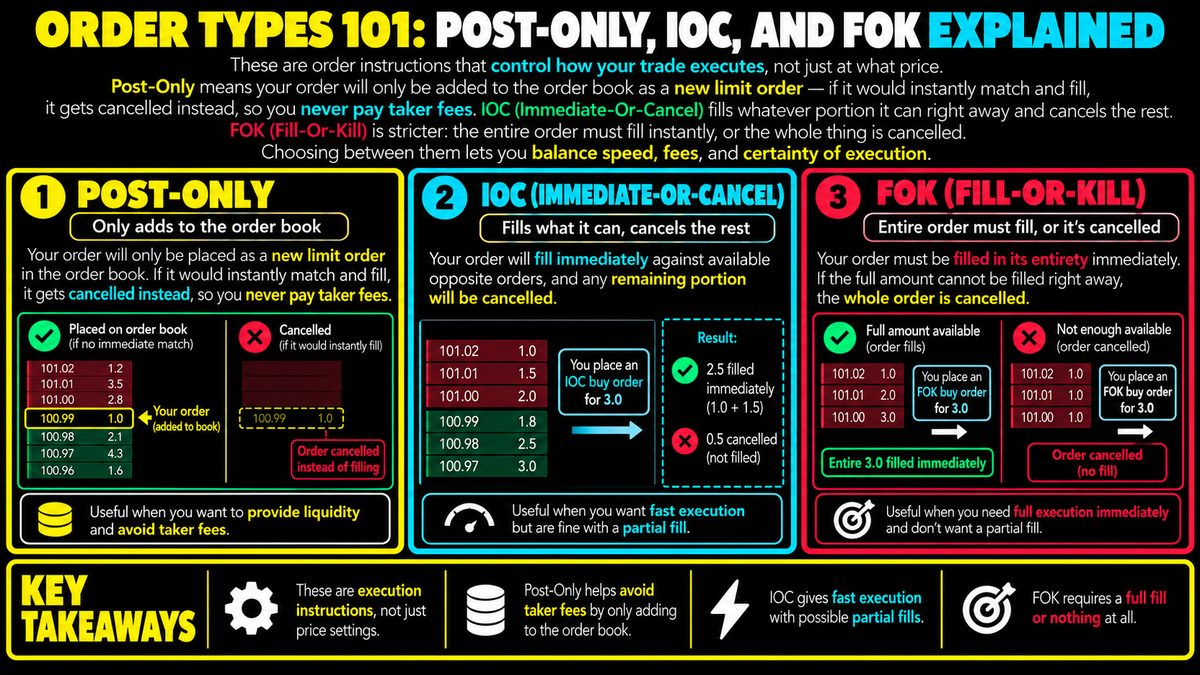
These are order instructions that control how your trade executes, not just at what price. Post-Only means your order will only be added to the order book as a new limit order — if it would instantly match and fill, it gets cancelled instead, so you never pay taker fees. IOC (Immediate-Or-Cancel) fills whatever portion it can right away and cancels the rest. FOK (Fill-Or-Kill) is stricter: the entire order must fill instantly, or the whole thing is cancelled. Choosing between them lets you balance speed, fees, and certainty of execution.
Why Order Instructions Matter
When you place a trade, you are not just choosing a price and an amount. You are also choosing how the exchange's matching engine should treat that order the instant it arrives. Should it wait patiently to be filled later, or does it need to execute right now? Should a partial fill be acceptable, or is it all-or-nothing? These choices are handled by order type instructions like Post-Only, IOC, and FOK. Understanding them helps you control execution risk, which is the chance that your trade fills at a worse price, fills only partially, or does not fill at all.
To understand these instructions, it helps to recall how an order book works. Buy and sell limit orders sit at different price levels waiting for a match. An order that adds new liquidity to the book is called a maker order. An order that immediately matches against existing orders and removes liquidity is called a taker order. Exchanges often charge different fees for each, with maker fees usually lower, since makers help create the book that takers rely on.
Post-Only Orders
A Post-Only order is an instruction that says, only add this to the order book as a maker order; never let it execute immediately as a taker. If you submit a Post-Only buy order at a price that would instantly match an existing sell order, the exchange cancels it instead of filling it. This guarantees you never pay a taker fee on that order, but it also means there is no guarantee your order gets filled at all. If the market moves away from your price, your order can sit unfilled indefinitely.
Traders often use Post-Only when they are not in a rush and want to minimize trading costs, for example when placing a resting limit order well ahead of where the price currently sits. The tradeoff is patience for cost savings, with no certainty of execution.
Immediate-Or-Cancel (IOC)
An IOC order tries to fill as much as it can the moment it hits the exchange, using whatever matching liquidity is available at acceptable prices. Any portion that cannot be filled instantly is cancelled rather than left sitting on the book. This makes IOC useful when you want fast execution but do not want a stray resting order left behind that might fill later at an unexpected price.
For example, imagine placing an IOC order to buy 100 units at a price of 100. If only 60 units are available at that price instantly, you receive 60 units filled and the remaining 40 are cancelled, rather than waiting on the book.
Fill-Or-Kill (FOK)
FOK is the strictest of the three. The entire order must be fillable immediately in full, or the whole order is cancelled with nothing executed. There is no partial fill. This is useful when a trader needs an all-or-nothing outcome, such as when a partial fill would leave an awkward, unbalanced position that is harder to manage.
The cost of this certainty is that FOK orders fail more often in thin or fast-moving markets, since the exchange must find enough matching liquidity at once.
Choosing Between Them
These instructions are tools for balancing three competing goals: minimizing fees, maximizing speed, and ensuring certainty of execution. Post-Only favors fee savings over certainty. IOC favors speed with partial flexibility. FOK favors completeness over likelihood of success. None of them predicts where price will go or guarantees a good outcome; they only control how your order behaves once submitted.
Limitations and Risk Management
Order types do not replace a trading plan, position sizing, or risk controls. Misusing them, such as relying on Post-Only in a fast market and missing fills entirely, can itself become a risk. Treat these instructions as execution tools to pair with your broader strategy, not as a substitute for careful analysis or risk management.