
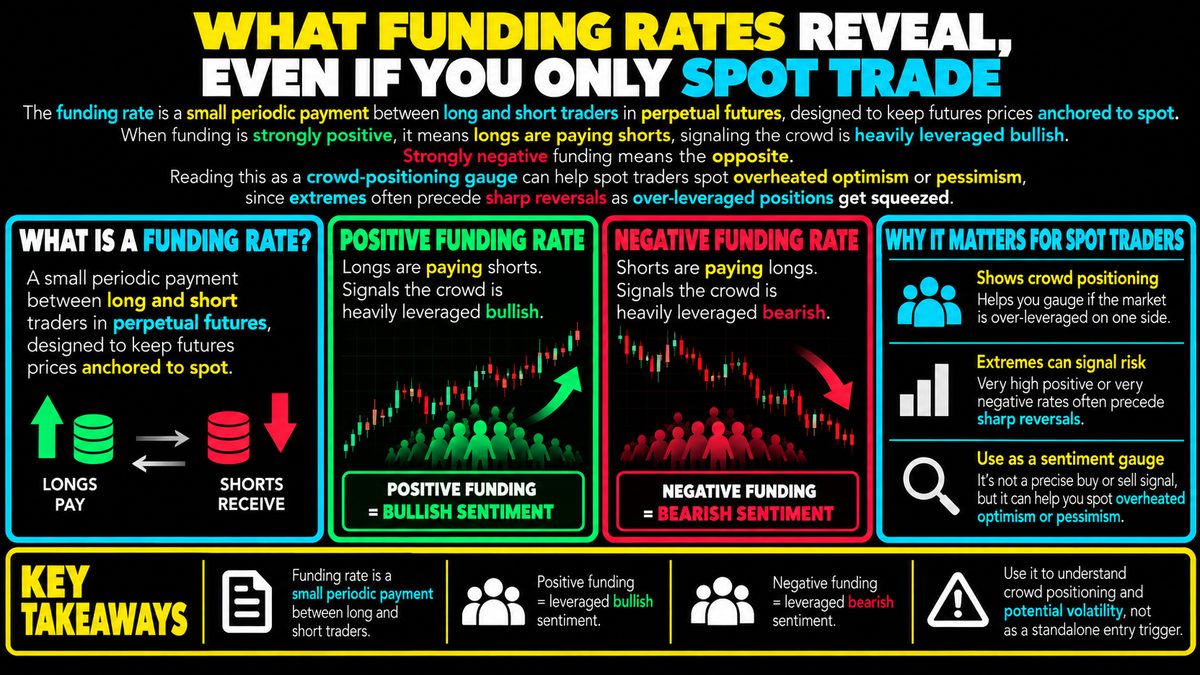
The funding rate is a small periodic payment between long and short traders in perpetual futures, designed to keep futures prices anchored to spot. When funding is strongly positive, it means longs are paying shorts, signaling the crowd is heavily leveraged bullish. Strongly negative funding means the opposite. Reading this as a crowd-positioning gauge can help spot traders spot overheated optimism or pessimism, since extremes often precede sharp reversals as over-leveraged positions get squeezed.
What A Funding Rate Actually Is
Perpetual futures are a type of crypto contract that lets traders bet on price direction without an expiry date, unlike traditional futures that settle on a fixed day. Because there is no expiry to force the contract price back in line with the actual market price of the coin, called the spot price, exchanges built in a mechanism called the funding rate. Every few hours, one side of the trade pays the other a small fee. This payment is not a fee collected by anyone running the exchange; it passes directly between traders holding opposite positions.
The purpose of this payment is purely to keep the futures price tethered to spot. If the futures price drifts too far above spot, funding turns positive and long position holders, those betting the price will rise, pay short position holders, those betting it will fall. This makes holding a long more expensive and holding a short more rewarding, which nudges traders to close longs or open shorts, pulling the futures price back down toward spot. The reverse happens when futures trade below spot.
Why The Direction And Size Matter
A funding rate near zero simply means longs and shorts are roughly balanced and futures pricing is well behaved. A strongly positive funding rate means there is a lot more leveraged buying pressure than selling pressure, since so many traders are willing to keep paying to stay long. Leveraged means they are using borrowed money to amplify the size of their position relative to the cash they put up. A strongly negative rate means the opposite, with leveraged short sellers dominating and paying to maintain their bets.
Because this imbalance reflects real money with real borrowing costs attached, it is often treated as a rough gauge of how one-sided or crowded the market's positioning has become, separate from what the price chart alone shows.
How Traders Use It As A Crowd Gauge
Spot traders, people who simply buy and hold the actual coin rather than trading contracts, do not pay or receive funding themselves. Still, many watch it because extreme readings can hint that a market has become overheated. If funding stays very positive for a sustained stretch, it suggests a large cluster of leveraged longs who are vulnerable to a sharp downside move, sometimes called a long squeeze, where falling prices force those leveraged positions to be closed, adding further selling pressure. Very negative funding can set up the mirror image, a short squeeze.
Some traders use this as one input alongside trading volume, order book depth, and broader trend analysis to judge whether a rally or sell-off looks increasingly fragile or overextended.
Common Mistakes And Limitations
A frequent error is treating funding extremes as a precise timing signal, as if a high reading guarantees an imminent reversal. In practice funding can stay elevated for long periods while prices keep moving in the same direction, so acting purely on this one number can mean fighting a strong trend prematurely.
Funding rates also differ across exchanges and are influenced by that specific venue's trader mix, so a reading in one place does not necessarily describe the whole market. It is also only a snapshot of leveraged derivatives activity, not of spot buying and selling, which can behave quite differently.
Fitting It Into A Broader Approach
Funding is best treated as context, not a standalone strategy. Pairing it with price structure, volume trends, and clear risk management, such as deciding in advance how much of a portfolio you are willing to risk, tends to be more useful than reacting to any single data point. No indicator, including funding rate, can reliably predict future price moves, and every market can behave in ways that defy historical patterns.