
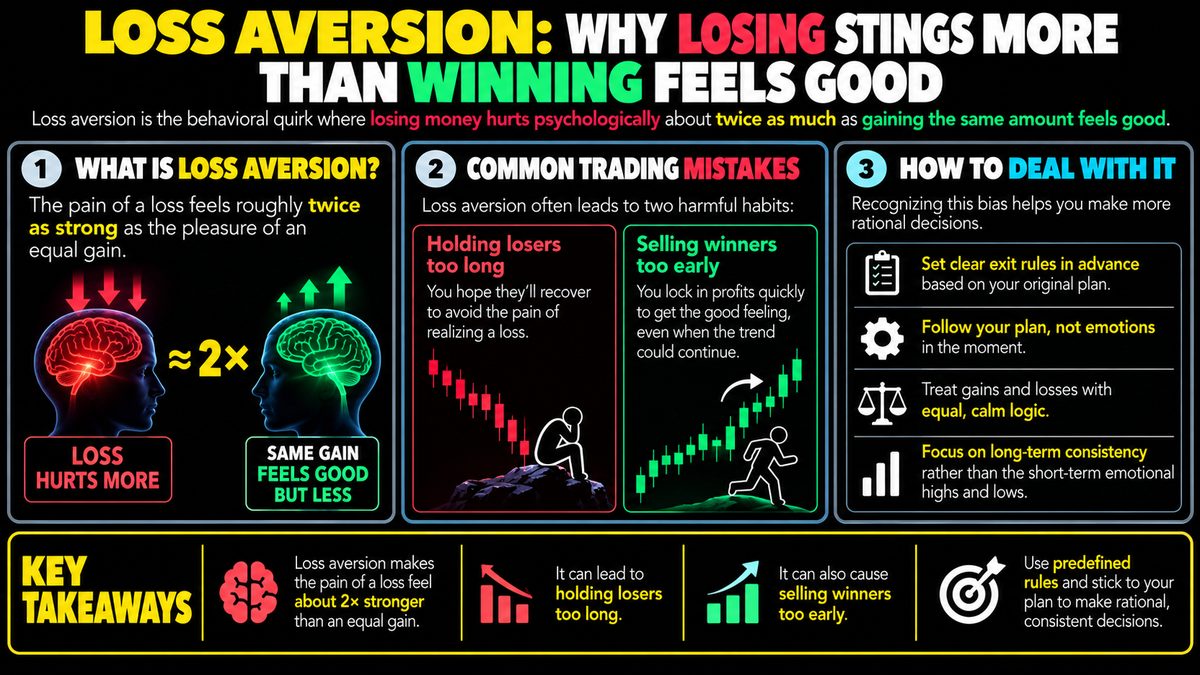
Loss aversion is the behavioral quirk where losing money hurts psychologically about twice as much as gaining the same amount feels good. In trading, this often causes two bad habits: holding losing positions too long hoping they'll recover, and selling winners too early to "lock in" the good feeling. Recognizing this bias helps you set exit rules in advance, based on your original plan rather than emotion in the moment. The goal is to treat gains and losses with equal, calm logic, not let fear of pain drive decisions.
What Loss Aversion Actually Means
Loss aversion is a well documented pattern in human decision making where the pain of losing something feels stronger than the pleasure of gaining the same thing. In simple terms, losing 100 units of value feels worse than gaining 100 units feels good, even though the amounts are identical. This is not a flaw in math, it is a quirk in how our brains weigh outcomes, and it shows up in everyday life, not just markets.
In trading, this bias matters because every open position is a constant stream of small emotional signals. A price moving against you does not just register as a number on a screen, it registers as a felt loss, and the brain reacts to protect against that feeling rather than evaluating the situation calmly.
How It Shows Up In Trading Behavior
The most common symptom is holding onto losing positions far longer than a trading plan would suggest. The logic in the moment is "if I sell now, the loss becomes real, but if I hold, maybe it recovers." This feels safer emotionally, even though the price action itself does not know or care what you paid for it.
The mirror image is selling winning positions too early. Once a trade is in profit, there is a fear of watching that profit shrink or disappear, so a trader locks in a small gain rather than letting a position play out according to its original plan. Imagine buying an asset at 100 and watching it rise to 110. Loss aversion can push someone to sell immediately just to avoid the discomfort of seeing it fall back toward 100, even if their original plan was to hold toward 130.
Why This Pattern Is Costly Over Time
The practical effect of these two habits combined is a portfolio that cuts winners short and lets losers run, which is often the opposite of what most trading strategies are built to do. Over many trades, this asymmetry can quietly erode results even if the trader is right about market direction more often than they are wrong.
It is worth being honest that loss aversion is not something you simply switch off by knowing about it. Awareness helps, but the emotional pull remains real, and most traders feel it to some degree no matter how experienced they are.
Building Rules Before Emotion Takes Over
One practical countermeasure is deciding exit points before entering a position, when thinking is calm and not influenced by an active gain or loss. This might include a predefined stop level where a losing trade is closed, and a predefined target or trailing approach for winners, set based on analysis rather than how the trade happens to be feeling in the moment.
Writing these levels down, or using order types that execute automatically, removes some of the in-the-moment decision making where loss aversion does the most damage. The point is not to guarantee better outcomes, since no rule set can do that, but to make decisions consistent with a plan rather than with fear.
Fitting This Into a Broader Approach
Loss aversion is just one of many behavioral biases that can affect trading decisions, and it rarely works alone. It often interacts with other habits like overconfidence after a win or anxiety after a loss, which can compound its effects.
Treating it as one input among many, alongside risk management practices like position sizing and diversification, is more realistic than expecting any single insight to fix decision making. No psychological concept, technical indicator, or rule set removes risk or predicts outcomes, and recognizing loss aversion is best understood as one small tool for thinking more clearly, not a guarantee of better results.