
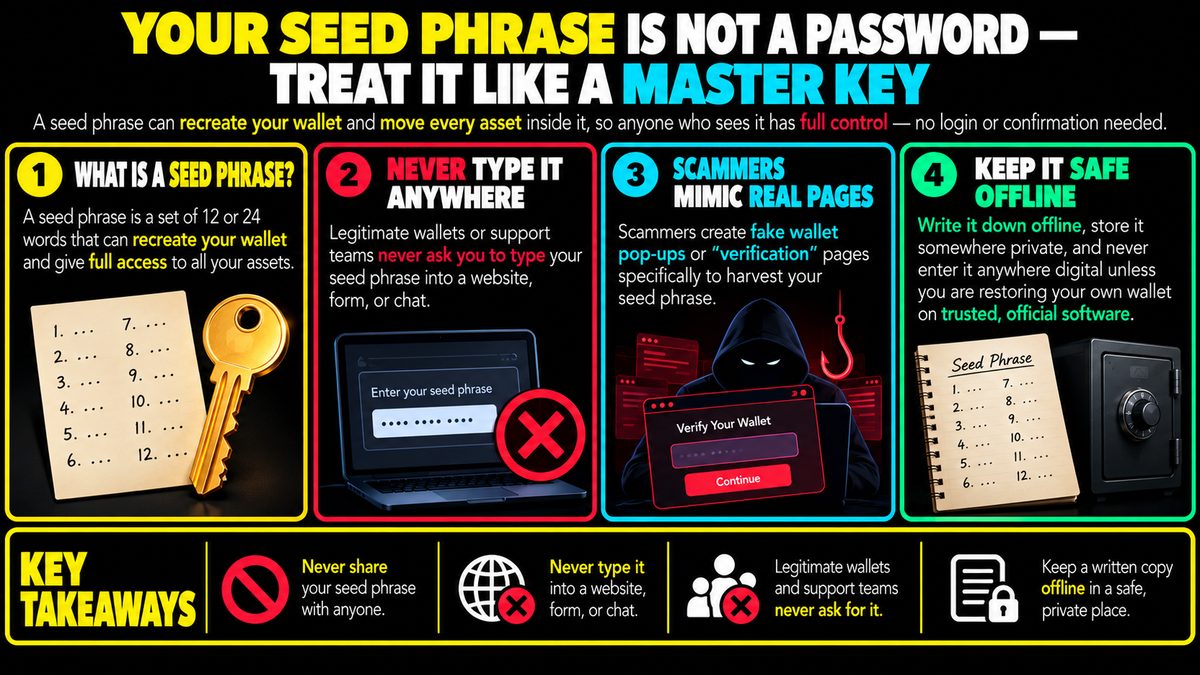
A seed phrase can recreate your wallet and move every asset inside it, so anyone who sees it has full control — no login or confirmation needed. Legitimate wallets or support teams never ask you to type it into a website, form, or chat. Scammers mimic wallet pop-ups or "verification" pages specifically to harvest these phrases. Write it down offline, store it somewhere private, and never enter it anywhere digital unless you are restoring your own wallet on trusted, official software.
What A Seed Phrase Actually Is
A seed phrase, sometimes called a recovery phrase or mnemonic phrase, is a list of usually twelve or twenty-four plain English words generated when you first set up a crypto wallet. Behind the scenes, those words mathematically encode the private keys that control every address and asset in that wallet. A private key is simply a secret number that proves ownership and authorizes transactions. Rather than making you memorize a long string of random characters, wallet software converts that secret into readable words so you can write it down and restore access later if your device is lost, stolen, or broken.
This is fundamentally different from a password. A password usually works with a username, can often be reset by a company if you forget it, and is checked by a server before granting access. A seed phrase has no such safety net. There is no company that issues it, no "forgot phrase" button, and no login screen standing between the phrase and your funds. Whoever types those words into compatible wallet software instantly gains the same control over the funds as the original owner, from any device, anywhere in the world.
Why Possession Equals Control
Because the seed phrase mathematically generates your private keys, there is no separate confirmation step once someone has it. They do not need your password, your device, your face, or your fingerprint. They do not need to "hack" anything in the traditional sense. They simply restore the wallet on their own software using your words, and the funds appear under their control, ready to be moved out.
This is why seed phrases are often compared to a master key for a vault rather than a password for an email account. A stolen password can frequently be changed before real damage is done. A seed phrase that has been seen by someone else should be treated as permanently compromised, because you cannot know if or when it will be used.
How Scammers Try To Get It
Scammers understand this dynamic well, so they design fake wallet pop-ups, fraudulent browser extensions, counterfeit support chats, and "verification" or "security check" pages that ask you to type your seed phrase to continue. These pages often mimic the look of legitimate software closely, sometimes even appearing after a real wallet update, to catch people off guard. Some scams create urgency, claiming your wallet will be locked or funds frozen unless you verify immediately.
No legitimate wallet provider, exchange, or support agent will ever ask for your seed phrase through a chat message, email, form, or website. The only moment a seed phrase should ever be entered is when you yourself are restoring your own wallet using official, trusted software that you deliberately opened.
Safer Ways To Store It
Because any digital copy can potentially be exposed through malware, cloud backups, screenshots, or phishing, many experienced users write their seed phrase on paper or stamp it into metal and store it somewhere private and physically secure, such as a safe. Avoiding photos, text files, notes apps, or cloud storage reduces the number of ways it could leak without your knowledge.
Some people also consider splitting storage across two locations or using wallets that support additional passphrases for extra layers, though added complexity can also increase the risk of losing access yourself, so simplicity and reliability often matter more than cleverness.
Putting It In Context
A seed phrase sits outside the realm of charts, indicators, or trading strategy entirely, but protecting it is arguably more foundational to risk management than any technical analysis tool. No pattern, signal, or security habit guarantees safety, and mistakes with a seed phrase are usually irreversible. Treating it with the seriousness of a master key, rather than a password you might casually reuse or type anywhere, is one of the simplest ways to reduce avoidable losses in this space.