
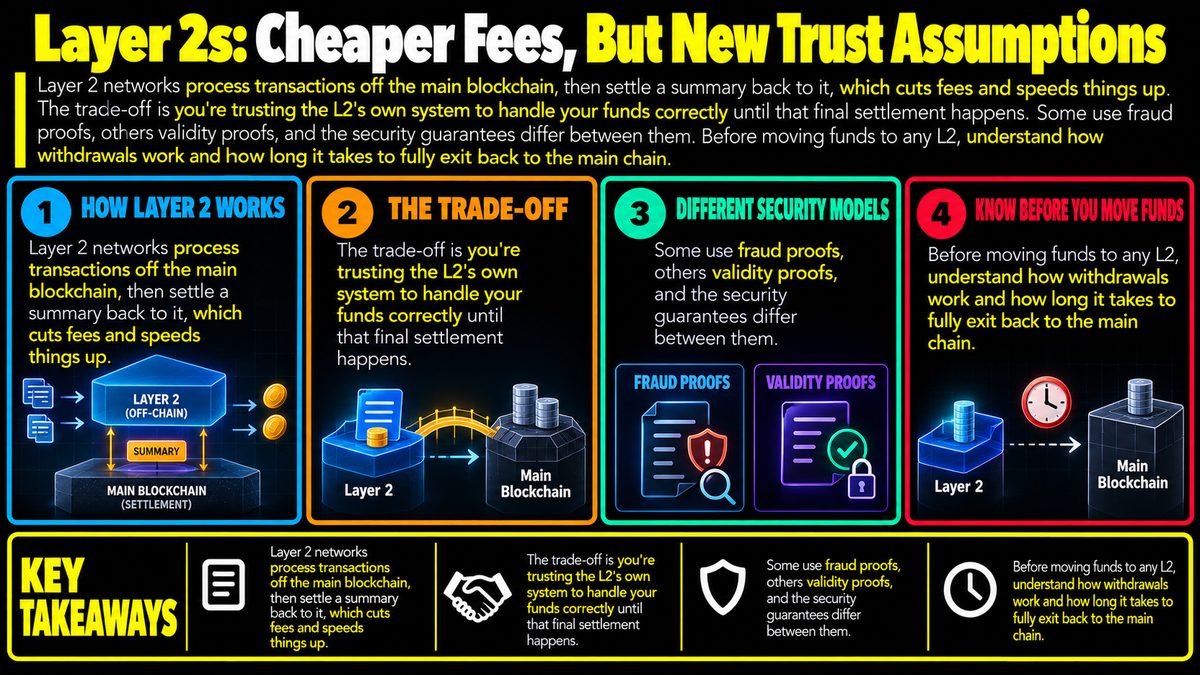
Layer 2 networks process transactions off the main blockchain, then settle a summary back to it, which cuts fees and speeds things up. The trade-off is you're trusting the L2's own system to handle your funds correctly until that final settlement happens. Some use fraud proofs, others validity proofs, and the security guarantees differ between them. Before moving funds to any L2, understand how withdrawals work and how long it takes to fully exit back to the main chain.
What a Layer 2 Actually Does
A base blockchain, often called a layer 1, processes every transaction itself and records it permanently. That gives strong security but limits how many transactions it can handle and often makes fees rise when the network gets busy. A layer 2 is a separate system built on top of that base chain. It takes in transactions, processes them on its own, and then periodically sends a compressed summary of all that activity back to the layer 1 for final record-keeping. Because the heavy lifting happens off the main chain, users typically see lower fees and faster confirmations.
The important nuance is that "faster and cheaper" comes with a different trust setup. When you send funds to a layer 2, you are relying on that network's own software and operators to track your balance correctly in the period before its data is fully settled on the base chain. Only once that settlement is finalized does the base chain's security fully back your funds.
How Transactions Get Verified
Layer 2s generally use one of two approaches to prove their off-chain activity was done honestly. The first, often called a fraud proof model, lets the network post its summary to the base chain immediately, but gives anyone a window of time to challenge it if they spot an error. If no one successfully challenges it within that window, the summary is treated as final. The second approach, a validity proof model, uses cryptographic math to prove the summary is correct before it is even posted, so there is no waiting period for challenges in the same way.
These are different engineering trade-offs, not a simple ranking of better or worse. Fraud proof systems can require longer withdrawal delays because of the challenge window, while validity proof systems can be more complex to build and verify. Neither model eliminates risk entirely, since bugs in the underlying code or unusual network conditions can still cause problems.
Why Withdrawals Are the Real Test
Depositing funds into a layer 2 is usually quick and simple. Withdrawing them back to the base chain is where the trust assumptions actually show up. In a fraud proof system, you may need to wait through the full challenge period before your exit is considered final, which could take anywhere from hours to days depending on the specific design. In a validity proof system, exits can sometimes be faster, but they still depend on the proof being generated and accepted correctly.
Before moving any meaningful amount of funds onto a layer 2, it is worth reading how that specific network describes its withdrawal process, including typical wait times and what happens if the network experiences downtime or disputes. A system that looks fast and cheap on the way in can feel very different on the way out.
Common Mistakes Traders Make
A frequent error is treating every layer 2 as equally secure simply because it sits on top of a well known base chain. The base chain's security does not automatically transfer to everything built on it. Another mistake is ignoring the operational side, such as whether a small number of parties currently control sequencing or upgrades, which can matter during stress events even if the long term design is meant to be more open.
Fitting This Into Risk Management
Layer 2s are tools, not guarantees of safety or profit. Treating fee savings as the only factor, while skipping research into withdrawal mechanics and proof systems, raises the kind of operational risk that has nothing to do with market direction. Sizing positions conservatively, diversifying where funds are held, and understanding exit timelines before you need them are reasonable habits regardless of which layer 2 design you are using.