
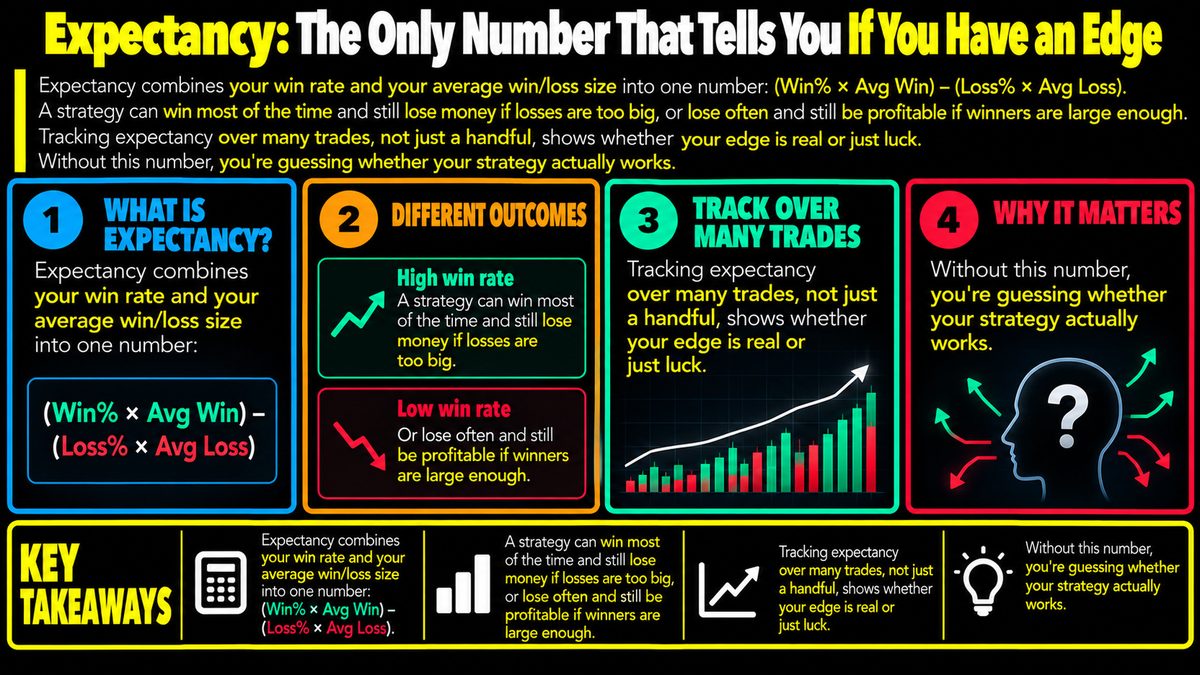
Expectancy combines your win rate and your average win/loss size into one number: (Win% × Avg Win) − (Loss% × Avg Loss). A strategy can win most of the time and still lose money if losses are too big, or lose often and still be profitable if winners are large enough. Tracking expectancy over many trades, not just a handful, shows whether your edge is real or just luck. Without this number, you're guessing whether your strategy actually works.
What Expectancy Actually Measures
Expectancy answers a simple question: on average, how much do you expect to make or lose per trade if you keep repeating the same strategy over and over. It is calculated as (win rate multiplied by average win) minus (loss rate multiplied by average loss). The result is a single number, usually expressed as an amount of money or a percentage of the amount risked per trade, that tells you whether your approach is mathematically sound over a large sample.
The key insight is that win rate alone tells you almost nothing. A trader who wins seven out of ten trades sounds skilled, but if the three losses are each three times bigger than the average win, that trader is losing money overall. Conversely, a trader who only wins three out of ten trades can still be profitable if those winners are large compared to the losses. Expectancy forces both sides of the equation, frequency and size, into one honest number.
How Win Rate and Payoff Interact
Imagine a hypothetical strategy that wins 40 percent of the time, with an average win of 150 units and an average loss of 50 units. Expectancy would be (0.40 × 150) minus (0.60 × 50), which equals 60 minus 30, or a positive 30 units per trade on average. Now imagine a different hypothetical strategy that wins 70 percent of the time but the average win is only 20 units while the average loss is 60 units. That gives (0.70 × 20) minus (0.30 × 60), or 14 minus 18, a negative 4 units per trade despite the much higher win rate.
These examples show why traders talk about the relationship between win rate and the size of wins versus losses, sometimes called the payoff ratio. A strategy with a low win rate can still have positive expectancy if winners are disproportionately large, and a high win rate strategy can quietly bleed money if losses are left to run.
Why Sample Size Matters
A handful of trades cannot reveal whether a strategy has genuine positive expectancy. Short strings of wins or losses are heavily influenced by randomness, especially in volatile markets. A trader might see five winning trades in a row and assume they have found a reliable edge, when in reality they were simply fortunate. Reliable expectancy numbers usually require tracking dozens or hundreds of trades under consistent rules, so that the averages settle into something closer to the strategy's true long-run behavior.
This is why many experienced traders keep a trading journal recording entry, exit, position size, and outcome for every trade. Without that record, it is easy to remember the big wins vividly and downplay the losses, creating a distorted sense of how the strategy actually performs.
Common Mistakes and Limitations
One common mistake is calculating expectancy from a small or cherry-picked set of trades, which produces a misleading figure. Another is ignoring fees, spreads, or slippage, which quietly erode real-world expectancy even when a theoretical calculation looks positive. Market conditions also change over time, so a strategy with solid historical expectancy is not guaranteed to keep performing the same way going forward.
Expectancy also says nothing about the emotional difficulty of a strategy. A system with frequent small losses and occasional large wins can be mathematically sound yet psychologically hard to follow consistently, which matters because expectancy only materializes if the rules are actually followed.
Fitting Expectancy Into a Trading Plan
Expectancy works best alongside clear risk management, such as deciding in advance how much of an account to risk per trade and sticking to it. It pairs naturally with position sizing discipline, since even a positive expectancy strategy can be ruined by risking too much on a single trade. No formula removes uncertainty from markets, and past expectancy is not a promise of future results, but tracking it honestly over time gives traders a clearer, less emotional view of whether their approach has a real statistical edge.