
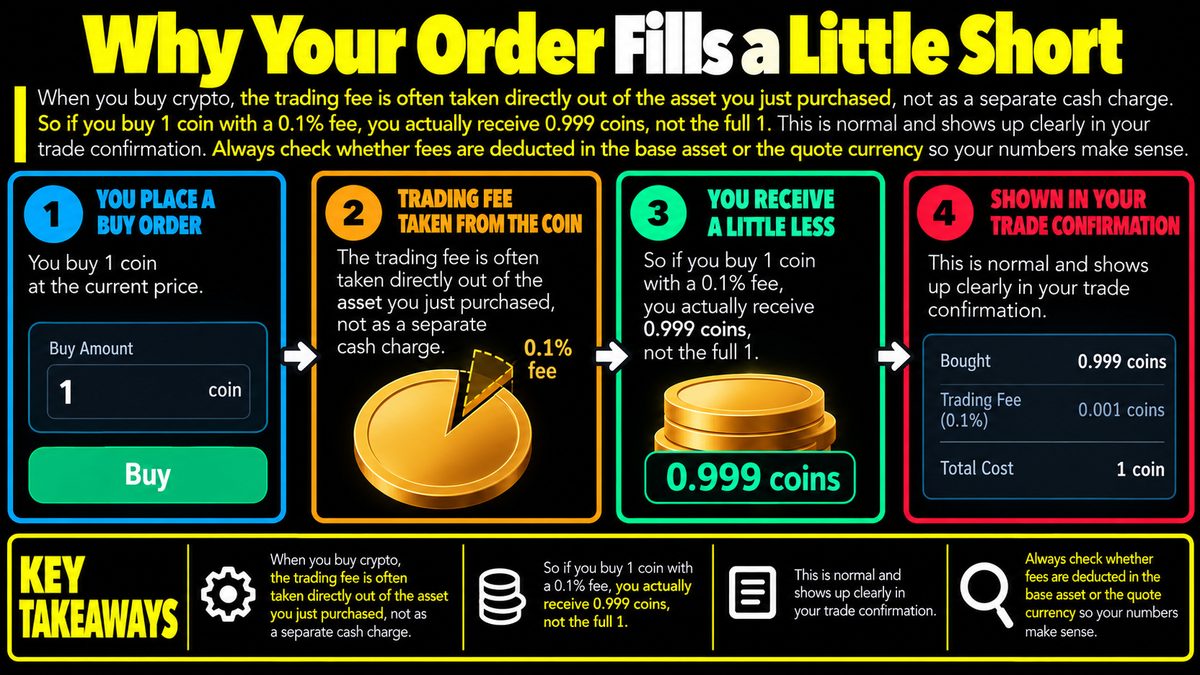
When you buy crypto, the trading fee is often taken directly out of the asset you just purchased, not as a separate cash charge. So if you buy 1 coin with a 0.1% fee, you actually receive 0.999 coins, not the full 1. This is normal and shows up clearly in your trade confirmation. Always check whether fees are deducted in the base asset or the quote currency so your numbers make sense.
Why This Happens
When you place an order to buy a coin, two things are moving at once: the money you are spending and the asset you are receiving. The trading fee has to be taken from one side of that trade, and on most platforms it is quietly taken from the asset you just bought rather than from your cash balance. So if you buy 1 coin and the fee is 0.1 percent, you do not end up holding 1 full coin. You end up holding 0.999 coins, because 0.001 of a coin was kept as the fee. Nothing went wrong and no one shortchanged you. This is simply how the math of "fee in kind" works, and it is standard across much of the industry.
Base Asset Versus Quote Currency
To understand this clearly, it helps to know two basic terms. The base asset is the thing you are buying, in this example the coin itself. The quote currency is what you are paying with, such as a stablecoin or cash balance. Fees can be deducted from either side depending on the platform, the order type, and sometimes whether you are buying or selling. When you buy, the fee is often taken from the base asset, meaning you receive slightly less of the coin than the headline amount suggests. When you sell, the fee is often taken from the quote currency instead, meaning you receive slightly less cash than expected. Checking which side the fee comes from, before and after a trade, prevents confusion later.
Reading Your Trade Confirmation
Every trade confirmation or order history entry will show the exact amount filled, the fee charged, and which asset that fee was taken from. It is worth actually opening this screen rather than assuming. If you bought 1 coin and the confirmation shows 0.999 coins credited plus a fee line of 0.001 coins, that is the full picture of what happened to your order. Over time, this small shaving adds up across many trades, so understanding it early helps your own records match what the platform shows, instead of leaving you wondering where a tiny fraction of your holdings went.
Why Traders Miscalculate Profit and Loss
A common mistake is tracking position size using the round number you intended to buy, like 1 coin, instead of the actual amount received after fees. This creates a small but real gap between a trader's mental spreadsheet and their actual wallet balance. The error gets worse with frequent trading, because each buy and sell clips a small amount, and those clips compound. None of this is dangerous on its own, but it can make a strategy look slightly more or less profitable than it really is if fees are not accounted for honestly in every calculation.
How This Fits Into Risk Management
Fees deducted in kind are a small example of a larger principle: always verify the actual mechanics of an order rather than assuming round numbers behave perfectly in practice. Slippage, minimum order sizes, and withdrawal fees all work the same way, quietly nudging real results away from the number you first typed in. Building the habit of checking confirmations, understanding which asset a fee comes from, and recording your true filled amount is a small but useful piece of disciplined trading. It will not predict where a market goes next, and no fee structure guarantees anything about outcomes, but understanding it removes one unnecessary source of confusion from your decision making.