
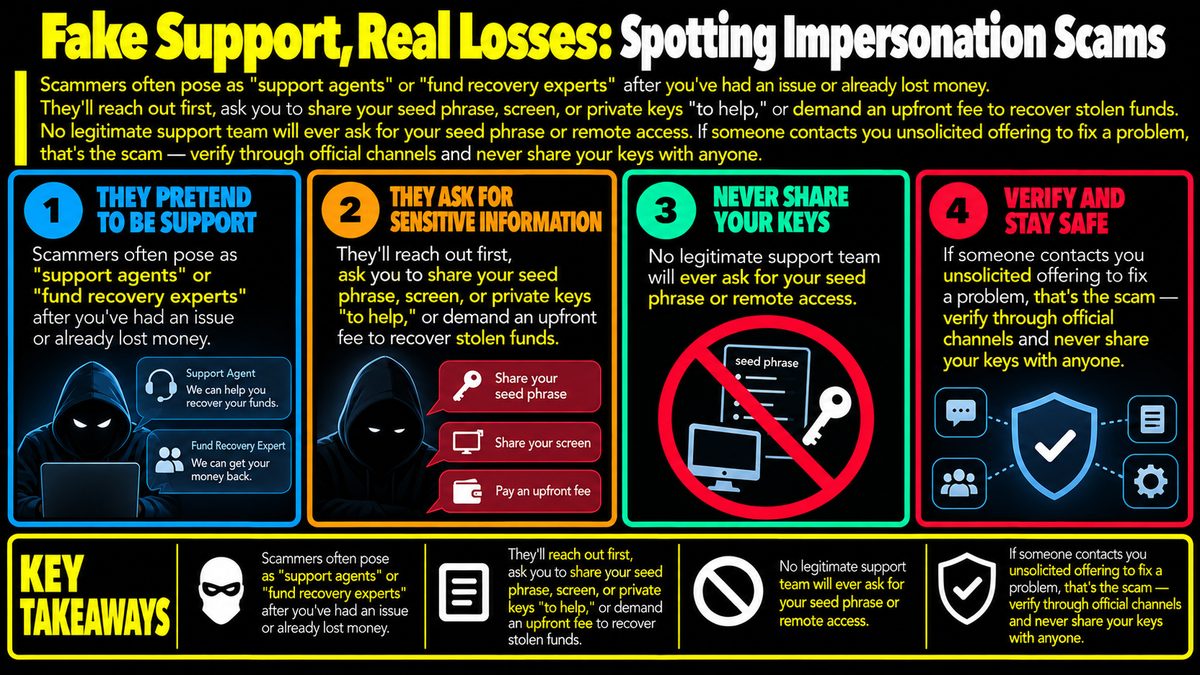
Scammers often pose as "support agents" or "fund recovery experts" after you've had an issue or already lost money. They'll reach out first, ask you to share your seed phrase, screen, or private keys "to help," or demand an upfront fee to recover stolen funds. No legitimate support team will ever ask for your seed phrase or remote access. If someone contacts you unsolicited offering to fix a problem, that's the scam — verify through official channels and never share your keys with anyone.
Why This Scam Works So Well
When you lose money or hit a technical snag, you are already anxious and looking for a quick fix. Scammers exploit that emotional state. They know that someone who just watched their balance disappear is more likely to skip careful verification and grab the first offer of help. This is a form of social engineering, meaning the attacker manipulates human psychology rather than breaking any code or system. The technology is not being hacked here; the person is.
How the Approach Usually Happens
Typically the scammer reaches out first. This could be a direct message on social media, a comment under a post where you mentioned a problem, a fake "support" account in a chat group, or even a phone call claiming to be from a wallet or exchange. They often pose as customer support, a blockchain security expert, or a fund recovery specialist who claims they can trace and return stolen crypto. Some build fake urgency, saying your account will be frozen or your funds permanently lost unless you act immediately.
The core request almost always involves one of three things. They ask for your seed phrase, which is the list of words that fully controls a wallet. They ask for remote access to your screen or device, often through a legitimate remote desktop tool used for illegitimate purposes. Or they ask for an upfront fee, paid in crypto, to begin a recovery process that never actually happens. Any of these should be treated as an immediate red flag.
The One Rule That Cuts Through Confusion
No legitimate support team, wallet provider, or exchange will ever ask for your seed phrase or private keys. There is no scenario where sharing that information is required to fix a problem, verify your identity, or recover funds. This single fact is worth memorizing because scammers constantly invent new scripts and platforms, but the ask stays the same. If you hear a request for your seed phrase, the conversation is over, regardless of how official the person sounds or how convincing their credentials appear.
A related rule applies to outreach direction. Genuine support almost never contacts you first out of nowhere. If you did not open a support ticket or publicly ask for help through an official channel, be skeptical of anyone who suddenly appears offering a solution.
Verifying Before Trusting
If someone claims to represent a company, close that conversation and go find the official contact method yourself, through the company's known website or app, rather than using any link or number the stranger provided. Compare the message against official channels you already trust. Be especially cautious of accounts with recently created profiles, slightly misspelled names, or urgency designed to prevent you from thinking it through.
Remember that once crypto transactions are confirmed on a blockchain, they generally cannot be reversed by any third party, no matter what they claim. This structural reality is why "fund recovery experts" asking for fees are almost always fraudulent.
Fitting This Into Broader Risk Management
Treating unsolicited help offers with suspicion is just one part of protecting yourself. Keeping seed phrases offline, never typing them into any website or chat, using hardware wallets where practical, and limiting how much personal activity you share publicly all reduce your exposure. No single habit guarantees safety, but combining skepticism toward unsolicited contact with sound key management meaningfully lowers the chance that a bad day turns into a much worse one.