
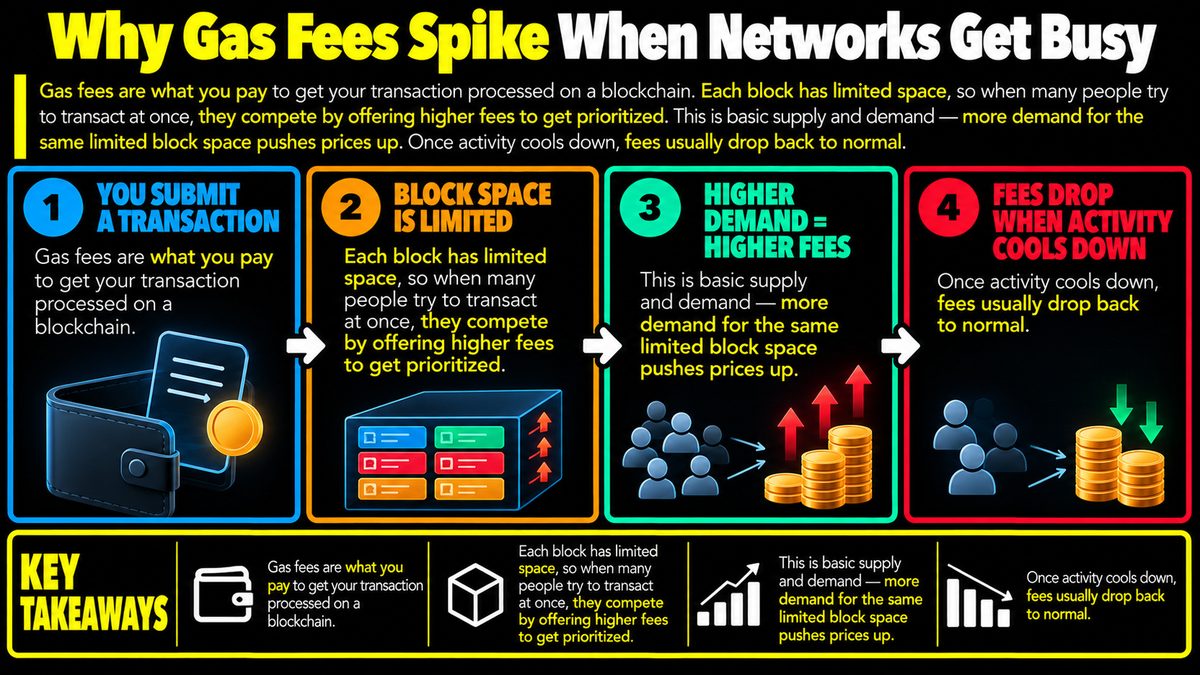
Gas fees are what you pay to get your transaction processed on a blockchain. Each block has limited space, so when many people try to transact at once, they compete by offering higher fees to get prioritized. This is basic supply and demand — more demand for the same limited block space pushes prices up. Once activity cools down, fees usually drop back to normal.
What Gas Fees Actually Pay For
Every blockchain transaction needs to be processed and recorded by the network. The people or machines doing that work, often called validators or miners depending on the blockchain, don't do it for free. The fee you pay, commonly called "gas" on many networks, is essentially a payment for computing resources and for the right to have your transaction included in the next batch of transactions, known as a block.
Think of a block as a container with a fixed amount of space. It can only hold so many transactions before it's full. That space is the scarce resource being auctioned off, and gas is the price of a seat in that auction.
Why Busy Networks Mean Higher Fees
Blockchains process transactions in blocks that are created at a roughly steady pace, and each block has a limited capacity. When few people are trying to transact, there's plenty of room, so fees stay low. When many people want their transaction processed at the same time, say during a popular token launch or a sudden rush of trading activity, they are all competing for the same limited block space.
This is a straightforward supply and demand dynamic. Supply, meaning available block space, stays roughly constant, while demand, meaning the number of people wanting in, rises sharply. To get included sooner rather than later, users attach higher fees as an incentive, since validators typically prioritize transactions offering the most compensation. As more people outbid each other, the going rate for a timely transaction climbs. Imagine a network where a transaction normally costs the equivalent of 1 unit of fee, but during a surge of activity it temporarily costs 10 units because everyone wants to get processed quickly.
How Traders Interpret Fee Spikes
Some traders watch gas fees as a rough signal of network activity or excitement around a particular event, since a sudden spike can indicate a surge of interest, like heavy trading, a popular new project launching, or a wave of automated bot activity. Elevated fees are sometimes read as a sign that something significant is happening on-chain, even before the underlying cause is fully clear.
However, this is a very imprecise signal. A fee spike tells you demand for block space increased, not why, and not whether that demand reflects something worth your attention. Treating fee spikes as a trading signal on their own is risky, since congestion can be caused by unrelated activity entirely disconnected from any opportunity.
Common Mistakes and Limitations
A frequent mistake is assuming high fees always mean a good opportunity is unfolding, when often it just means the network is inefficient at that moment or that unrelated automated activity is clogging the queue. Another mistake is setting a fee too low during busy periods, which can leave a transaction stuck for a long time or cause it to fail outright, sometimes while still costing money for the attempt.
Gas fees also vary significantly between different blockchains, since each network has its own capacity and fee structure. A fee that seems high on one network might be considered normal or even low on another, so comparisons across chains without context can be misleading.
Fitting Fees Into a Broader Strategy
Gas fees are one small piece of understanding how a blockchain behaves under load, not a standalone trading strategy. They are more useful as a cost consideration, factored into risk management, than as a predictive tool. Frequent trading during high-fee periods can quietly erode returns, so it's worth accounting for fees alongside other factors like volatility and liquidity.
No fee pattern, spike, or lull guarantees anything about future price movement. Gas fees reflect demand for processing transactions, not the merits of any asset, and should be treated as context rather than a signal to act on by itself.