
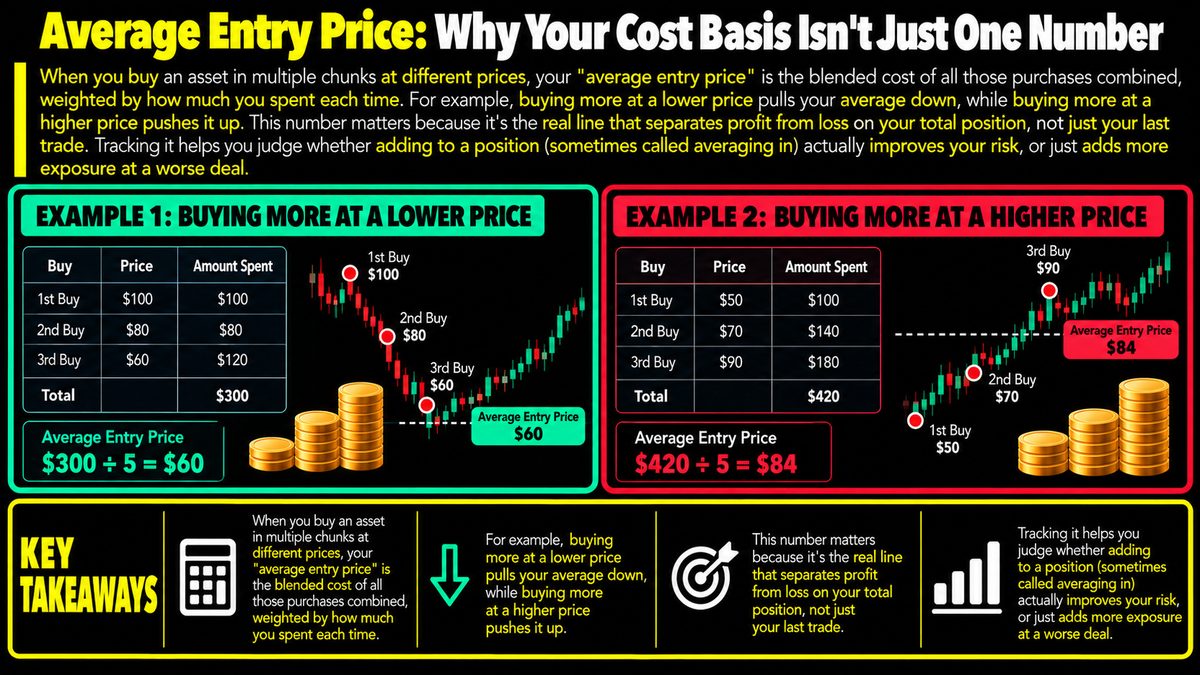
When you buy an asset in multiple chunks at different prices, your "average entry price" is the blended cost of all those purchases combined, weighted by how much you spent each time. For example, buying more at a lower price pulls your average down, while buying more at a higher price pushes it up. This number matters because it's the real line that separates profit from loss on your total position, not just your last trade. Tracking it helps you judge whether adding to a position (sometimes called averaging in) actually improves your risk, or just adds more exposure at a worse deal.
What Average Entry Price Actually Means
When you buy a crypto asset more than once, each purchase happens at its own price. Your average entry price is not simply the midpoint of those prices, it is a weighted blend based on how much money or how many units you put into each purchase. If you buy more units at one price than another, that price pulls the average harder in its direction. This matters because many traders mistakenly think of their "entry" as just the last trade they made, when really their financial exposure is tied to the combined average of everything they currently hold.
To calculate it, you take the total amount spent across all purchases and divide it by the total number of units you now own. Imagine buying 1 unit at 100 and later buying 1 more unit at 200. You spent 300 total for 2 units, so your average entry price is 150, not 100 or 200. This blended number is the real breakeven line for your whole position.
How Adding to a Position Changes the Average
When traders buy more of an asset after the price drops, this is often called averaging in or dollar cost averaging down. Adding units at a lower price pulls your average entry down, which can reduce the distance you need the price to recover before you are breakeven. Conversely, buying more after the price has risen pushes your average up, meaning you now need a higher price to stay in profit on the whole position.
Neither direction is automatically good or bad. Averaging down can look appealing because it lowers the breakeven point, but it also increases the total amount of money exposed to an asset that has already moved against you. It is simply math, not a guarantee that the price will recover.
Why Average Entry Price Is Not a Signal
A common mistake is treating average entry price as if it tells you something about where the market is headed. It does not. It is purely a record of your own trading history, not a prediction, support level, or indicator of future direction. The market has no awareness of your cost basis and does not behave differently because you are above or below it.
Another frequent error is using average entry price as the sole reason to keep adding to a losing position, sometimes called catching a falling knife. Repeatedly buying more just to lower the average can turn a small position into an oversized one, increasing risk without any corresponding analysis of whether the original reason for buying is still valid.
Using It Alongside Risk Management
Average entry price becomes more useful when paired with a plan decided in advance, such as a maximum amount you are willing to allocate to a position or a predefined point where you would reconsider the trade altogether. Some traders combine it with other tools, like technical analysis or portfolio-level risk limits, rather than relying on cost basis alone to make decisions.
It is also worth remembering that average entry price only reflects unrealized outcomes until you actually sell. Price moving above or below your average does not lock in a gain or loss, it only shows where you currently stand on paper.
The Bottom Line
Average entry price is a useful bookkeping tool for understanding your true cost basis across multiple purchases, but it is not a strategy on its own. No formula for blending entry prices can tell you what an asset will do next, and treating it as a signal rather than a record is a common and costly misunderstanding.